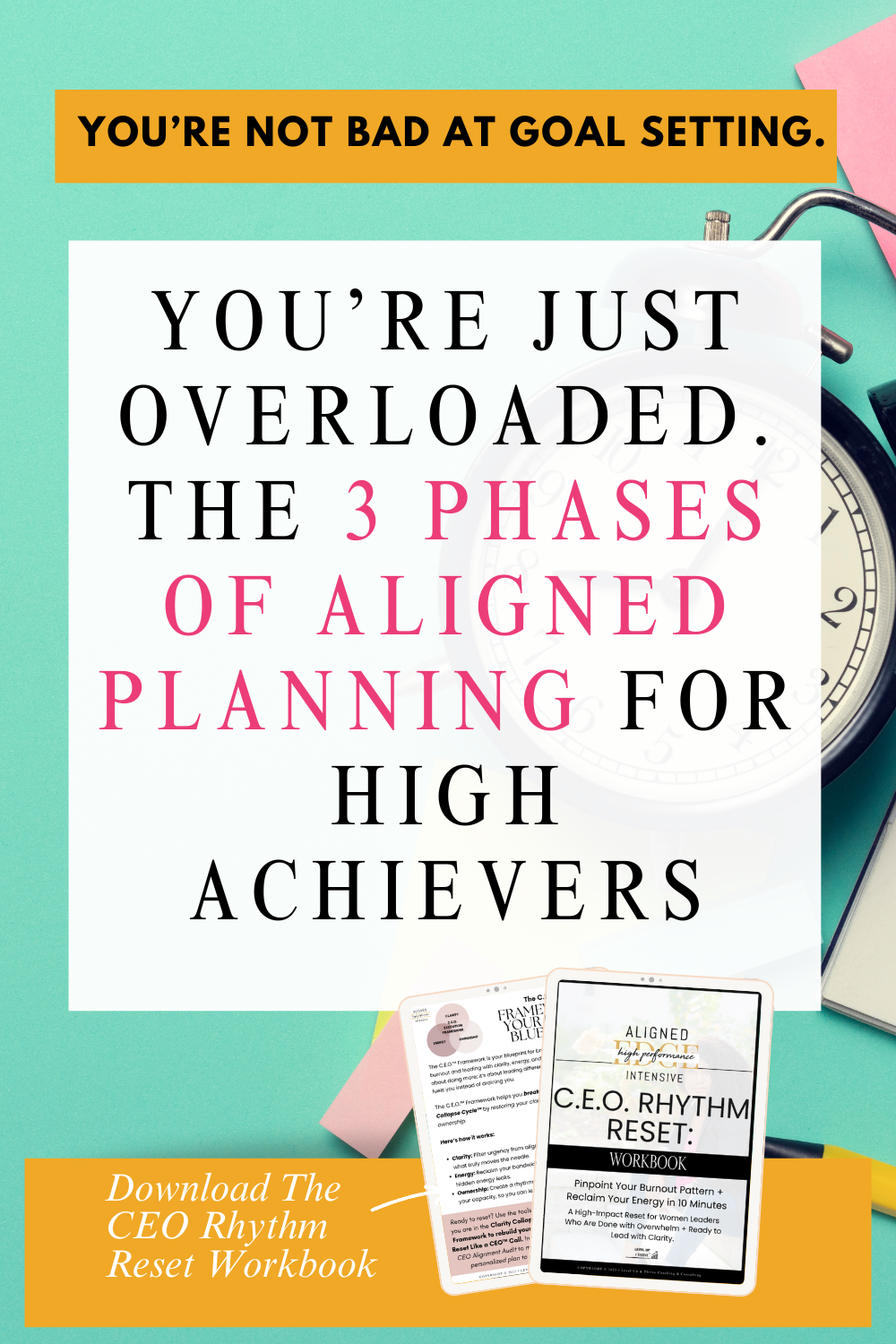
You’re Not Bad at Goal Setting. You’re Just Overloaded. The 3 Phases of Aligned Planning for High Achievers
The Problem Isn’t Your Goals
It’s the State You’re Setting Them From
You’re not stuck because you lack clarity.
You’re stuck because you keep trying to plan from the same internal state that burned you out last year.
That’s the part no one tells high achievers.
Every year, you sit down with good intentions.
A fresh calendar. A clean page. A quiet promise that this year will be different.
And every year, the plan looks solid on paper, but something in your body already knows it won’t hold.
If goal setting feels heavier than it used to…
If “mapping the year” tightens your chest instead of energizing you…
That’s not resistance.
That’s your nervous system saying, not like this again.
Let’s be clear about something.
Your ambition isn’t the problem.
Your goals aren’t unrealistic.
And your ability to follow through isn’t broken.
What’s off is when you’re trying to plan,
and what you’re carrying while you do it.
Because when you’re holding unfinished decisions, emotional labor, invisible responsibility, and the pressure of being the one who keeps everything moving…
Clarity doesn’t disappear.
It goes offline.
“You don’t lose motivation when you’re overloaded. You lose access.”

And that’s why so many capable, intelligent, driven people keep asking themselves the same quiet question:
I know what to do… so why does this feel so hard?
That question isn’t a personal failure.
It’s a signal.
It’s your brain asking for a different approach; one that actually respects how it works.
The work I do lives right here, at that intersection between ambition and biology, between leadership and capacity.
Because planning doesn’t fail when you don’t want it badly enough.
It fails when you try to build the future on top of exhaustion.
What I want to walk you through here isn’t a new way to push harder.
It’s a different way to lead yourself; one that starts by stabilizing the system, clarifying what actually matters, and committing in a way that builds self-trust instead of eroding it.
That shift changes everything.
New here?
I’m Felecia Etienne; former corporate executive turned high-performance coach and leadership strategist.
I help ambitious leaders and entrepreneurs build success that actually holds by aligning Clarity, Energy, and Ownership instead of running on pressure and adrenaline.
If you’ve outgrown hustle culture but still care deeply about your impact, you’re in the right place.
Let’s talk about what’s really been getting in the way, and how to plan from a state that finally supports you.
Why This Keeps Happening (Even When You’re Capable)
Here’s the deal.
If planning has started to feel harder over time, it’s not because you’re losing your edge.
It’s because you’re carrying more than you used to.
More responsibility.
More decisions.
More invisible weight.
And your brain feels that.
At the center of planning, prioritizing, and following through is the prefrontal cortex, the part of your brain that helps you think ahead, make decisions, and hold multiple things at once.
It’s essentially the CEO of your brain.
And like any good leader, it has limits.
When that system gets overloaded, by constant decisions, emotional labor, unresolved mental loops, and the pressure of being the one who holds everything together, it doesn’t get sharper.
It gets tired.
So instead of offering clarity, it starts conserving energy.
When your brain is overloaded, clarity doesn’t disappear; it goes offline.
That’s not laziness.
That’s protection.
Related article: Unlocking Sustainable Success: Balancing Well-being and Ambition for a fulfilling life
Why Cognitive Load Isn’t a Mindset Issue
Here’s the bottom line:
Your brain can only hold so much information at one time before performance drops.
That’s cognitive load.
And if you’re a high achiever, you’ve probably ignored this more times than you can count.
Not because you don’t understand it, but because you’ve been rewarded for pushing past it.
So you keep:
holding unfinished decisions in your head
tracking tasks mentally instead of externally
remembering what everyone else needs
carrying emotional responsibility no one sees
This is what I call cognitive transference; when mental and emotional weight never fully gets set down. It just keeps moving from moment to moment, task to task, season to season.
Nothing ever really closes.
An overloaded system can’t plan clearly.
It can only react.
That’s why you can know exactly what you want…
and still feel foggy, avoidant, or strangely resistant when it’s time to map it out.
The Quiet Cost of Decision Fatigue
Every decision costs energy.
When your days are filled with constant prioritizing, emotional regulation, and problem-solving for others, your brain starts looking for shortcuts.
Not because you don’t care, but because you’re tired of deciding.
That’s decision fatigue.
And it often shows up as:
Procrastination that doesn’t match your ambition
Overthinking small choices
Avoiding planning altogether
Starting strong, then stalling
This is why “just try harder” never works.
Effort doesn’t restore capacity.
It drains it faster.
How Overload Messes With Your Confidence
Here’s the part most people don’t connect.
Chronic overload doesn’t just affect productivity; it quietly erodes self-efficacy, your belief in your ability to follow through.
When you keep setting goals you can’t sustain, not because you’re incapable, but because you’re overloaded; your brain starts telling a story:
Maybe I’m inconsistent.
Maybe I can’t trust myself.
Maybe this is just how I am.
That’s learned self-doubt.
Not because you failed, but because the system you were operating in was unsustainable.
Burnout isn’t a failure of discipline.
It’s a signal of capacity mismanagement.
And the harder you push, the tighter that loop becomes.
Why Pressure Makes Clarity Worse
Pressure narrows perception.
When stress is high, the brain prioritizes survival over strategy.
Short-term relief over long-term vision.
Reaction over reflection.
So when you try to plan from pressure, you’re asking a stressed system to do the very thing it’s least equipped to do: think ahead.
That’s why planning can feel overwhelming instead of empowering.
It’s not that you don’t want clarity.
It’s that your nervous system doesn’t feel safe enough to access it.
And this is the shift most people miss:
Clarity doesn’t come from forcing focus.
It comes from reducing load.
Which is why aligned planning doesn’t start with goals.
It starts by stabilizing the system that has to carry them.
Related article: Resilience Isn’t a Mindset—It’s a Method: Why High-Performing CEOs Need More Than Hustle to Scale
Why Traditional Goal Setting Backfires for High Achievers
Here’s what I want you to hear, and I say this with a lot of respect for how capable you are:
Traditional goal setting isn’t failing because you’re doing it wrong.
It’s failing because it was never designed for people carrying the level of responsibility you are.
Most of the advice out there assumes you’re starting from neutral.
Plenty of energy. Minimal emotional load. Clean mental space.
That’s not real life for high achievers.
And when I work with clients, this is usually the moment they get frustrated. They’ve done the planners. The frameworks. The vision boards. The discipline.
They don’t need another system telling them to “lock in and execute.”
They need a plan that accounts for capacity, not just ambition.
Goals First vs. Capacity First
Traditional goal setting starts with what you want.
Aligned planning starts with what you can actually hold ; consistently, honestly, without burning yourself out.
Here’s the metaphor I often use with clients:
Traditional goal setting is like slamming the gas pedal without checking what’s under the hood.
Aligned planning starts by making sure the engine can actually support the speed you want to go.
When you set goals that ignore capacity, the plan may look exciting, but it feels heavy almost immediately.
That heaviness isn’t weakness.
It’s feedback.
Pressure-based planning creates goals your nervous system eventually rejects.
I see this all the time in coaching sessions. A client lays out an ambitious plan, then quietly says, “Why does this already feel like too much?”
That question matters.
Motivation vs. Regulation
Most advice tells you to find more motivation.
But here’s the truth:
Most high achievers learn the hard way:
Motivation doesn’t override a dysregulated nervous system.
When you’re already stretched thin, motivation becomes unreliable. It shows up in bursts, then disappears; not because you don’t care, but because your system is tired.
Regulation is what restores access.
When the nervous system settles, clarity returns.
When clarity returns, motivation follows.
Not the other way around.
That’s why trying to “pump yourself up” often backfires. You’re asking a stressed system to perform instead of helping it stabilize first.
Willpower vs. Systems
Traditional goal setting relies heavily on willpower.
And if you’re a high achiever, you probably have plenty of it.
But willpower is like a battery, and you’re already using it everywhere else.
Aligned planning shifts the burden away from willpower and onto systems.
Systems:
reduce decision fatigue
create momentum without constant effort
support execution on low-energy days
When execution lives inside a system instead of your head, it stops feeling personal.
You’re no longer negotiating with yourself every day.
You’re following a structure you trust.
That’s not weakness.
That’s leadership.
When Goals Turn Into Identity Verdicts
This is one of the most important shifts, and the one that changes everything.
High achievers don’t just set goals.
They make goals mean something.
When progress slows, it’s not just disappointing; it feels personal.
I hear this in client conversations all the time:
“I should be better than this.”
“Why can’t I just stay consistent?”
“Other people seem to handle more.”
Goals quietly turn into identity verdicts.
Miss a milestone → something’s wrong with me.
Fall behind → I’m slipping.
Need to slow down → I’m failing.
And once shame enters the picture, execution becomes fragile.
If your plan feels punishing on day one, it’s already misaligned.
Aligned goals don’t demand proof of worth.
They’re designed to build self-trust, not erode it.
Why Trying Harder Makes the Loop Worse
Here’s the trap.
When traditional goal setting fails, high achievers don’t question the model.
They question themselves.
So they push harder. Tighten control. Raise the bar. Add more pressure.
But effort doesn’t fix misalignment.
It amplifies it.
Trying harder in an unsustainable system is like running faster on a treadmill that never turns off. You’re working, but you’re not actually going anywhere.
And eventually, your system pushes back.
That’s why the answer isn’t more discipline.
It’s a different approach; one that respects how your brain works, how identity shapes behavior, and how capacity determines consistency.
Which is why aligned planning doesn’t start with pushing forward.
It starts with stabilizing the system that has to carry the plan.
Related article: THE POWER OF THE WEEKLY CEO POWER HOUR: SAVE TIME, ACHIEVE MORE THROUGH CONSISTENT PLANNING
“If planning makes your brain go blank, it’s not a clarity problem. It’s a capacity problem.”
Phase 1: STABILIZE
Why This Always Comes First
Let me be very clear about this, because this is the part high achievers are most tempted to skip:
If you try to plan without stabilizing first, everything else will cost you more energy.
More effort.
More friction.
More self-doubt.
I have never seen clarity stick without this phase. Not once.
Because planning cannot begin in dysregulation.
And energy always precedes execution.
You can have the smartest goals in the world, but if the system carrying them is overloaded, they will eventually collapse under their own weight.
The Mistake Most High Achievers Make
When clients first come to me, they usually think they need:
sharper goals
better priorities
stronger follow-through
What they actually need is relief.
Not a break.
Not a mindset shift.
Relief from carrying everything in their head.
And this is where I want to catch you for a second, because if you’re anything like the high achievers I work with, you’re probably thinking:
“I get this… but I don’t really need to slow down.”
“I can handle a little more.”
“I’ll stabilize later; let me just get clear first.”
That instinct is exactly why this phase matters.
You don’t need more clarity.
You need fewer open mental tabs.
Why Stabilization Isn’t Optional
When your nervous system is under pressure, your brain prioritizes survival over strategy.
Urgency over perspective.
Reaction over reflection.
Short-term relief over long-term thinking.
That’s not a character flaw.
That’s biology.
So when planning feels exhausting instead of empowering, it’s not because you’re resistant to clarity.
It’s because your brain is asking you to set some things down before you ask it to build anything new.
Stabilization isn’t slowing down; it’s removing friction.
The Mental Download (The First Non-Negotiable Step)
This is the exact place I start with every client.
Not with goals.
Not with vision.
With a Mental Download.
Because until what’s in your head gets out of your head, your brain will keep running background processes you don’t even realize are there.
Here’s how it works:
First, you externalize everything.
Tasks. Loose ends. Ideas. Worries. Conversations you keep replaying. Decisions you haven’t made yet.
No organizing.
No prioritizing.
No fixing.
You’re not trying to solve your life; you’re unloading it.
Next, you separate what you wrote into three buckets:
Actions: things that can actually be done
Decisions: things that require a yes, no, or not now
Emotional load: pressure, guilt, responsibility, mental weight
This is where most people have their first real breakthrough.
Because once emotional load is named, it stops disguising itself as a productivity problem.
And then, and this is critical, you choose one relief move.
Not ten.
Not a full overhaul.
One thing that would make you feel even 10% lighter.
That might be:
completing one small action
making one clean decision
acknowledging one emotional truth you’ve been carrying
That’s it.
This is not about doing more.
It’s about making space.
What This Changes in Your Brain
When you externalize your mental load, your working memory frees up.
Your nervous system settles.
Your prefrontal cortex, the part of your brain responsible for planning and focus, comes back online.
This is why clarity so often shows up after you unload, not before.
You didn’t suddenly become more disciplined.
You just stopped asking your brain to carry everything at once.
And here’s the shift that changes everything:
Clarity is a response to reduced load.
Not a reward for pushing harder.
Why Skipping This Phase Always Backfires
If you skip stabilization, here’s what happens:
You overestimate capacity
You under-resource execution
You mistake stress for motivation
You make goals mean something about you
And when things wobble, because they will, you don’t adjust the plan.
You question yourself.
That’s the cost of skipping this phase.
Stabilization protects your energy, your clarity, and your self-trust.
Which is why it always comes first.
Once the noise clears, clarity can finally land; without force, without pressure, and without self-betrayal.
And that’s exactly where we go next.
Because Phase 2 isn’t about doing more.
It’s about choosing better.
“Your brain doesn’t move on pressure. It moves on progress.”
Phase 2: CLARIFY
Stop Carrying Everything Forward
Once the noise clears, there’s a moment most people don’t expect.
You don’t feel the urge to add more.
You feel the need to drop things.
This is where clarity actually begins, and where high achievers are most likely to second-guess themselves.
Because clarity isn’t about filling the space you just created.
It’s about deciding what no longer comes with you.
If everything still matters, nothing is clear.
Clarity Is an Identity Decision (Not a Productivity One)
Here’s the truth I want to say plainly:
Clarity isn’t a time-management problem.
It’s an identity decision.
When your identity bar is undefined, everything stays open.
Every opportunity feels like a maybe.
Every request carries weight.
Every goal gets dragged forward “just in case.”
When I work with clients, this is the moment they realize they’ve been planning for a version of themselves that no longer exists.
A version with different energy.
Different priorities.
Different capacity.
And until that identity bar is updated, clarity will always feel slippery.
Your goals should reflect who you’re becoming, not who you’re trying to prove you are.
That one shift alone removes more pressure than most productivity systems ever will.
RELATED ARTICLE: DARE TO EMBRACE FLOW: HOW TO ACHIEVE SUSTAINABLE SUCCESS WITHOUT SACRIFICING YOUR WELL-BEING
“Planning fails when you ask a stressed system to make strategic decisions.”

The Leadership Shift Most People Avoid
Here’s where resistance shows up.
You might notice yourself thinking:
“But what if I let the wrong thing go?”
“What if I should be able to handle this?”
“What if saying no means I’m shrinking?”
This is where leadership gets real.
Because clarity requires letting something go.
Not later.
Now.
High achievers don’t struggle with ambition.
They struggle with over-identification.
They keep carrying goals, roles, and expectations that belonged to a past season ; and wonder why everything feels heavy.
Clarity asks a sharper question:
What does leadership look like in this season of my life, not in theory, but in reality?
Answering that honestly is what separates aligned growth from quiet burnout.
Seasonal Leadership: The Permission Most People Never Take
Not every season is meant for expansion.
Some seasons are for:
consolidation
depth over breath
refinement instead of reach
But high achievers often resist this because they confuse restraint with regression.
That’s a mistake.
Seasonal leadership isn’t about doing less because you can’t handle more.
It’s about choosing what actually deserves your energy right now.
This is the reframe that changes everything.
Direction: What Actually Matters This Season
Clarity doesn’t start with a five-year plan.
It starts with direction, for this season.
When clients name this clearly, the mental noise drops almost immediately. Because direction creates boundaries without force.
You stop asking:
Should I be doing this too?
What if I miss out?
And start saying:
“This matters now.”
“That can wait.”
“This is no longer mine to carry.”
Clarity isn’t about choosing more.
It’s about choosing better.
Decision Filters: How Leaders Protect Their Bandwidth
Once direction is clear, decision-making changes.
Not because life gets simpler, but because you stop renegotiating the same questions.
Decision filters answer:
What gets a yes this season?
What’s a clean no?
What’s a not-right-now?
This is capacity-aware leadership in action.
When your filters are clear, your nervous system doesn’t have to stay on alert.
You already decided.
That’s how cognitive dissonance dissolves; not through willpower, but through alignment.
Non-Negotiables: The Line That Makes Clarity Hold
This is the part most people skip, and the part that determines whether clarity lasts.
Non-negotiables aren’t rules.
They’re supports.
They protect:
energy
integrity
self-trust
When I work with clients, this is where planning shifts from aspirational to sustainable.
Non-negotiables sound like:
“I don’t plan without recovery built in.”
“I protect deep work time.”
“I don’t override my body to hit a deadline.”
This is where intrinsic motivation turns on.
Because when goals align with values, not expectations, follow-through stops feeling forced.
Why This Phase Creates Real Momentum
Clarity reduces internal conflict.
You stop arguing with yourself.
Second-guessing every decision.
Carrying goals that don’t belong to you anymore.
Instead, you feel grounded.
Aligned.
And alignment creates momentum without pressure.
This is the Clarity pillar of the C.E.O.™ Framework in action.
You’re not doing less because you can’t handle more.
You’re doing less because you finally know what matters.
Phase 3: COMMIT
Execution Without Self-Betrayal
This is the phase most people think goal setting is about.
Commitment.
Follow-through.
Execution.
And it’s also the phase where high achievers have learned to be the hardest on themselves.
Because somewhere along the way, commitment got confused with pressure.
And discipline got confused with punishment.
Aligned commitment doesn’t work like that.
“If your follow-through only works when you’re hard on yourself, that’s not discipline. That’s pressure.”

Why Commitment Has Felt So Fragile
Let me say this clearly, because it matters:
Most high achievers don’t struggle with commitment because they lack willpower.
They struggle because the way they were taught to execute breaks trust instead of building it.
This is the moment I see over and over in my work.
A client sets a meaningful goal.
They start strong.
Then life happens: a missed week, a sick kid, a work curveball, a dip in energy.
And suddenly the goal isn’t just off track.
It means something.
“See? I can’t stick to anything.”
“Why do I always do this?”
“What’s wrong with me?”
That’s not a motivation problem.
That’s a design problem.
Dopamine Doesn’t Reward Pressure.. It Rewards Progress
Here’s the part most goal-setting advice gets wrong.
Your brain doesn’t stay engaged because you told it to “try harder.”
It stays engaged because it can see progress.
That’s dopamine.
Dopamine isn’t a finish-line reward.
It’s the fuel that keeps you moving before the finish line.
That’s why:
Games keep you hooked
Checking boxes feels satisfying
visible progress creates momentum
When the only payoff is at the end, your nervous system disengages long before you get there.
This is exactly where execution usually collapses.
Not because the goal wasn’t important, but because the brain stopped getting feedback that effort was working.
Why Finish-Line-Only Goals Fail
Finish-line-only goals assume uninterrupted energy.
That’s not real life.
Life is going to life.
Plans will shift.
Energy will fluctuate.
Something unexpected will take priority.
When progress isn’t visible along the way, one missed beat feels like failure, and that’s where people quit.
Not consciously.
Quietly.
Aligned commitment designs execution for reality, not perfection.
How Aligned Execution Is Built
This is where execution stops being personal and starts being strategic.
Here’s the structure I walk clients through when follow-through keeps breaking down:
Goals become projects.
No more vague ambition floating in your head.
Projects become milestones.
Clear points of progress your brain can recognize.
Milestones get acknowledged.
Not dismissed. Not rushed past. Not minimized.
This is where momentum comes from.
Not pressure.
Not self-talk.
Progress you can see.
When milestones are clear, your nervous system stays engaged, even when things slow down.
Compassion Is the Backbone of Integrity
This part matters more than people expect.
Compassion is not letting yourself off the hook.
It’s what keeps you coming back.
Because integrity isn’t perfection.
Integrity is returning.
Commitment without compassion creates burnout.
Commitment with compassion creates self-trust.
This is the exact moment execution usually breaks:
Someone misses a milestone and makes it mean they’ve failed.
Aligned ownership responds differently.
It says:
“Okay. Something shifted. We’re adjusting; not quitting.”
That moment, choosing to return instead of abandoning yourself, is where self-trust is rebuilt.
Not when you’re perfect.
When you’re honest and consistent.
Ownership Isn’t Doing Everything
This is the exhale most high achievers don’t realize they’re waiting for.
Ownership is not:
carrying everything
overfunctioning
proving your worth through output
Ownership isn’t doing everything.
It’s doing the right thing consistently.
Aligned commitment asks one grounding question:
What is the one thing that makes everything else easier?
The Lead Domino: One Lever That Changes the System
Every season has a lead domino.
One priority.
One lever.
One operating-system shift.
Not ten goals.
Not a full identity overhaul.
When this is clear, execution simplifies fast.
Because instead of trying to win everywhere, you build momentum where it actually matters.
This is where commitment stops feeling heavy and starts feeling clean.
What This Phase Actually Creates
Aligned commitment doesn’t just move goals forward.
It rebuilds:
trust with yourself
confidence in your follow-through
belief that you can handle what you choose
That’s the real outcome.
Not perfect execution.
Not endless motivation.
Self-trust.
And once self-trust is restored, commitment no longer feels like a risk.
It feels like ownership.
The Full Framework, Reclaimed
This is the order that works; every time:
Stabilize the system so clarity can return
Clarify what actually matters in this season
Commit in a way that builds trust instead of breaking it
Not hustle.
Not pressure.
Not punishment.
Leadership: directed inward first.
And when you lead yourself this way, execution stops being a fight.
It becomes something you can rely on.
What Changes When You Plan This Way
This is usually the moment something softens.
When I walk clients through this process, there’s a pause; not because they’re confused, but because they finally feel the difference.
They’ll say things like:
“This feels… lighter.”
“I’ve never planned like this before.”
“I don’t feel like I’m already failing.”
And that’s when I know we’re in the right place.
Because aligned planning doesn’t hype you up.
It settles you down.
You Stop Making Everything Mean Something About You
One of the first shifts I see is this:
The inner narrative changes.
Instead of:
“Why can’t I stay consistent?”
“What’s wrong with me?”
“I should be further along by now…”
It becomes:
“Okay. This makes sense.”
“I can work with this.”
“This feels doable.”
That reduction in self-judgment isn’t accidental.
It happens because the plan was built to support you, not test you.
And when self-judgment drops, energy returns.
Execution Starts to Feel Clean; Not Heavy
This is where people are usually surprised.
They don’t suddenly become more disciplined.
They become less fragmented.
They know:
what matters
what doesn’t
what they’re not carrying anymore
So execution stops feeling like a grind and starts feeling like follow-through.
Not because they’re pushing harder, but because they’re no longer fighting themselves.
This is the difference between dragging a plan forward
and being supported by it.
Aligned plans feel supportive at the starting line; not punishing.
Your Ambition Stops Feeling Like a Liability
Here’s something I see all the time with high achievers:
They start to mistrust their ambition.
They worry it’s what keeps burning them out.
But ambition isn’t the problem.
Misalignment is.
When you plan this way, ambition stabilizes.
It’s no longer fueled by urgency, fear, or proving.
It’s fueled by clarity, capacity, and ownership.
That’s when ambition becomes sustainable; not something you have to manage or suppress.
You Start Trusting Yourself Again
This is the shift that matters most.
Aligned planning rebuilds self-trust.
Not because everything goes perfectly; but because when life happens, you know how to return without spiraling.
You stop quitting on yourself.
You stop resetting every time things wobble.
You stop turning normal disruption into evidence that you “can’t follow through.”
Instead, you adjust and continue.
That’s integrity.
And that’s what makes momentum last.
Why I Teach Planning This Way
This framework wasn’t created in theory.
It was built inside real coaching conversations with people who were capable, driven, and exhausted from trying to plan their way out of overwhelm.
People who didn’t need more goals.
They needed a different relationship with execution.
This is exactly what I walk you through inside my training; step by step, so you can experience this shift in real time.
Not as a concept.
As a practice.
If This Landed, Here’s Your Next Step
If you felt yourself nodding while reading this…
If you recognized your own patterns in these examples…
If planning has started to feel heavy instead of supportive…
The training below will walk you through this entire process: stabilizing your system, clarifying what matters, and committing in a way that builds self-trust instead of breaking it.
No pressure.
No hype.
Just a different way of planning; one that actually holds.
You can download the training below when you’re ready.
related article: THE POWER OF THE WEEKLY CEO POWER HOUR: SAVE TIME, ACHIEVE MORE THROUGH CONSISTENT PLANNING
“You don’t lose motivation when you’re overloaded. You lose access.”
Goal Setting questions high achievers ask:
1. Why does goal setting feel overwhelming for high achievers?
You fall off your goals not because you don’t care, but because your system no longer trusts the way goals have been handled in the past.
High achievers set goals in moments of clarity.
They’re calm. Motivated. Certain.
Then execution happens inside real life. Fatigue. Interruptions. Pressure. A calendar that never fully clears.
When that gap repeats often enough, something subtle breaks.
Not motivation.
Self-trust.
Your brain starts associating goals with overextension instead of progress. Even meaningful goals begin to register as risk. So hesitation shows up. Delay. Quiet resistance. Not because you don’t want the outcome, but because your system is trying to protect you from another cycle of push, drop, and self-disappointment.
This is the part most people miss:
Every time a goal collapses, the cost isn’t the missed milestone. It’s the erosion of follow-through confidence. Decision-making gets heavier. Planning feels tense. You start lowering expectations without realizing it.
That’s not a discipline issue.
That’s a trust issue.
And until goals are designed in a way your system can actually sustain, caring more won’t fix it. It will only make the fallout louder.
2. How does cognitive overload affect motivation and focus?
Cognitive overload doesn’t kill motivation. It buries it under too many open loops.
High achievers rarely lack desire. What they lack is mental white space. Every decision not fully closed keeps drawing from the same limited pool of executive function. Eventually, the brain shifts out of focus mode and into conservation mode.
That’s why you can sit down to work, know exactly what matters, and still feel oddly resistant. Not distracted. Not lazy. Just heavy. As if everything takes more effort than it should.
Over time, this creates a dangerous misread. You start questioning your drive when the real issue is capacity. And the longer overload goes unaddressed, the more motivation becomes unreliable on demand.
That erosion doesn’t announce itself loudly.
It shows up as hesitation where confidence used to live.
3. What is the best way to plan goals without burnout?
Burnout doesn’t happen because goals are too big. It happens because they’re planned without regard for the system expected to carry them.
Most high achievers plan goals from an outcome mindset. Timelines. Metrics. Endpoints. What gets ignored is the ongoing cost of sustaining pressure long enough to reach them. When that cost isn’t accounted for, the nervous system compensates by shutting down motivation later.
This is why burnout often surprises capable people. On paper, the plan made sense. In reality, it required a level of urgency and self-push that couldn’t be maintained.
The problem isn’t that you planned poorly.
It’s that planning never included capacity as a constraint.
And any goal that requires you to override your system will eventually train it to resist.
Related Article: 13 Simple Goal Setting Techniques that work even when you feel uncertain
4. How does dopamine affect motivation and follow-through?
Dopamine influences motivation by teaching the brain what effort is worth repeating.
Not through rewards, but through pattern recognition.
When progress never registers, when the finish line keeps moving, or when pressure replaces satisfaction, the brain stops associating effort with payoff. Follow-through weakens not because you’ve lost discipline, but because the system no longer expects relief on the other side.
High achievers are especially vulnerable to this because they normalize constant push. Wins blur together. Completion doesn’t land. The brain doesn’t get to close the loop.
Over time, motivation becomes inconsistent. Not absent. Unreliable. Available sometimes, gone when needed most.
That inconsistency isn’t random.
It’s learned.
And without restructuring how effort and completion are experienced, caring more only deepens the frustration.
5. What’s the difference between discipline and self-trust in goal achievement?
Discipline relies on force.
Self-trust relies on evidence.
Discipline says you’ll push no matter what. Self-trust says you understand your limits well enough to build within them. High achievers usually have discipline in excess. What quietly erodes over time is trust in their own execution.
When goals repeatedly require self-override, the system learns that commitment equals strain. Eventually, discipline starts to feel expensive. Planning gets tense. Follow-through feels fragile. You begin negotiating with yourself before you even begin.
That’s when discipline stops working. Not because you’ve softened, but because trust has been depleted.
Sustainable goal achievement doesn’t come from asking more of yourself.
It comes from rebuilding the internal evidence that when you commit, your system won’t have to pay for it later.

P.S. If you're looking for deeper support as you navigate this transformative journey, here are two ways I can help:
Master Your Mindset: I specialize in helping high achievers, business owners, and professionals break into the top 1% of their field by mastering their mindset and boosting their performance. When you're ready to take your success to the next level, DM me the word "Edge," and let's start that conversation.
Free Resource for Change: Don’t let negative emotions hold you back! Grab my Self-Sabotage Solution Checklist: a free tool designed to help you identify and release the limiting beliefs that no longer serve you. Take the first step toward a more empowered you today!
Embrace this opportunity to shift from burnout to brilliance. Your path to sustainable success starts now!
Ready to achieve your dream life? I’m Felecia Etienne, your go-to Certified High-Performance Coach™ and Mental Fitness Coach. Let me take you on a transformative journey with a Complimentary Unlock Your Performance EDGE call. This isn’t just a chat, it’s your ticket to the high-performance tools and techniques I’ve shared with my coaching clients.
In this personalized call, you'll:
- Dive into your dreams and goals, tackle obstacles, and bridge the gap between where you are and where you want to be.
- Uncover and combat triggers of self-sabotage while discovering untapped strengths.
- You'll walk away with actionable strategies that deliver immediate impact
Equip yourself with the strategies, resources, and support needed to shatter obstacles, self-sabotaging, narrow the gap, and transform your ambitions into tangible achievements. Ready to escape inertia and boost your impact? Book a private and confidential session. Unlock Your Performance EDGE with Felecia. Let's unlock your potential together.
To find out more about Felecia, you can visit her website at feleciaetienne.com.
Social Media Handles:
Feeling stuck and unfulfilled? It's time to break free from self-sabotage!
Download our Self-Sabotage Solution Checklist and
start your journey to personal mastery today.