THE PROCRASTINATION LIE: Why High Performers Procrastinate on the Work That Matters Most

Why High Performers Procrastinate on the Work That Matters Most
The unfinished work may not be proof that you need more discipline. It may be showing you what consumed your attention, energy, and capacity before the important work ever got a turn.
The proposal has been open on your laptop since Monday.
You know it matters. You blocked time for it. You may have even moved two meetings around so you could finally sit down and finish it.
But every time you open the document, something else gets handled first.
You answer the email that will only take a minute. You respond to the question someone has already asked twice. You clear a few smaller tasks so you can focus without all the noise sitting in the background.
By the time you return to the proposal, the hour you protected is almost gone.
So you move it to tomorrow.
Then tomorrow becomes Thursday. Thursday becomes the end of the week. And at 9:47 p.m., you are staring at the same unfinished work, wondering why you could not make yourself do the one thing you said mattered most.
That is usually where the self-blame starts.
You tell yourself you should have been more focused. More disciplined. Better at protecting your time.
You know how to work hard. That has never been the issue.
What is harder to see is what happened before the important work ever got a fair chance.
Why Procrastination Feels Like a Discipline Problem
You Know How to Get Things Done
The delay is confusing because getting things done is usually one of your strengths.
You know how to meet a deadline, carry responsibility, and push through when something needs to be handled. Other people may even depend on you because they know you will figure it out.
So when an important project keeps getting moved, the most obvious explanation is that you failed to apply enough discipline to it.
Maybe you should have started earlier.
Maybe you should have protected the time better.
Maybe you should have ignored the messages, closed the tabs, and forced yourself to focus.
That explanation feels believable because it puts the problem somewhere familiar: your effort.
But effort is not the only thing deciding whether important work gets done.
A task can matter deeply and still become difficult to start when too much has already happened before you reach it. The decisions you carried, the interruptions you absorbed, the problem that followed you out of the last meeting, and the work no one else could move without you all take something.
By the time you sit down, the time may still be there.
Your access to your best thinking may not be.
That is the part most productivity advice misses. It looks at the unfinished task and assumes the failure began there.
Often, it began much earlier.
Procrastination Is the Signal, Not the Diagnosis
This is the part most productivity advice leaves out.
It sees the unfinished task and assumes the problem started when you failed to begin.
So you try another planner. You move the work to the top of the list. You protect an hour on the calendar and promise yourself that this time, nothing will interrupt it.
You have already tried that version.
The list was made. The time was blocked. The task still followed you into the next week.
That is why the unfinished work needs to be read differently.
The proposal is where the delay became visible. It is not necessarily where the problem began.
By the time you opened it, you may have already carried a morning of decisions, interruptions, unfinished conversations, and work that kept finding its way back to you.
A better system can organize the task.
It cannot automatically restore the attention, capacity, or emotional room that was already used somewhere else.
The procrastination is real.
But it is the signal that something underneath the task needs to be named.
Procrastination Is the Receipt, Not the Problem
The Work Didn’t Stall Because You Lack Discipline
This is where the discipline story starts to fall apart.
The work did not sit there because you suddenly became less capable.
By the time you reached it, starting required more attention, energy, or emotional effort than you had available.
That is not a small distinction.
“I lack discipline” turns the delay into a judgment about you.
“Something made this harder to access” gives you information.
And information gives you somewhere useful to look.
The Task Was Carrying More Than the Task
Some work arrives with more weight attached to it than the other things on your list.
The proposal may contain a number that makes the outcome feel personal. Sending it may open the door to a no. Finishing it may force a decision you have been able to postpone while the document stays open.
Keeping it unfinished can feel safer than letting the result become real.
But emotional weight is not the only thing the proposal was carrying.
It also arrived after the client question you handled first, the conversation that never reached a clear ending, the decision you kept revisiting, and the smaller tasks that gave you a quick sense of completion.
By 9:47 p.m., the proposal had not suddenly become more difficult.
You simply had less available for it.
Sometimes the Task Is Where the Week Tells on Itself
Look beyond this one proposal, and the pattern may feel familiar.
Last week had its own unfinished thing.
The draft you almost completed. The decision you kept carrying. The follow-up you planned to send when you had a better minute.
The individual delay rarely looks significant enough to question.
But the pattern adds up.
An important decision stays open. A priority loses its protected place. The work that asks more of you keeps getting pushed behind whatever is easier to close.
None of that proves you are undisciplined.
Sometimes procrastination is the receipt from a week that kept spending you before your priorities got a turn.
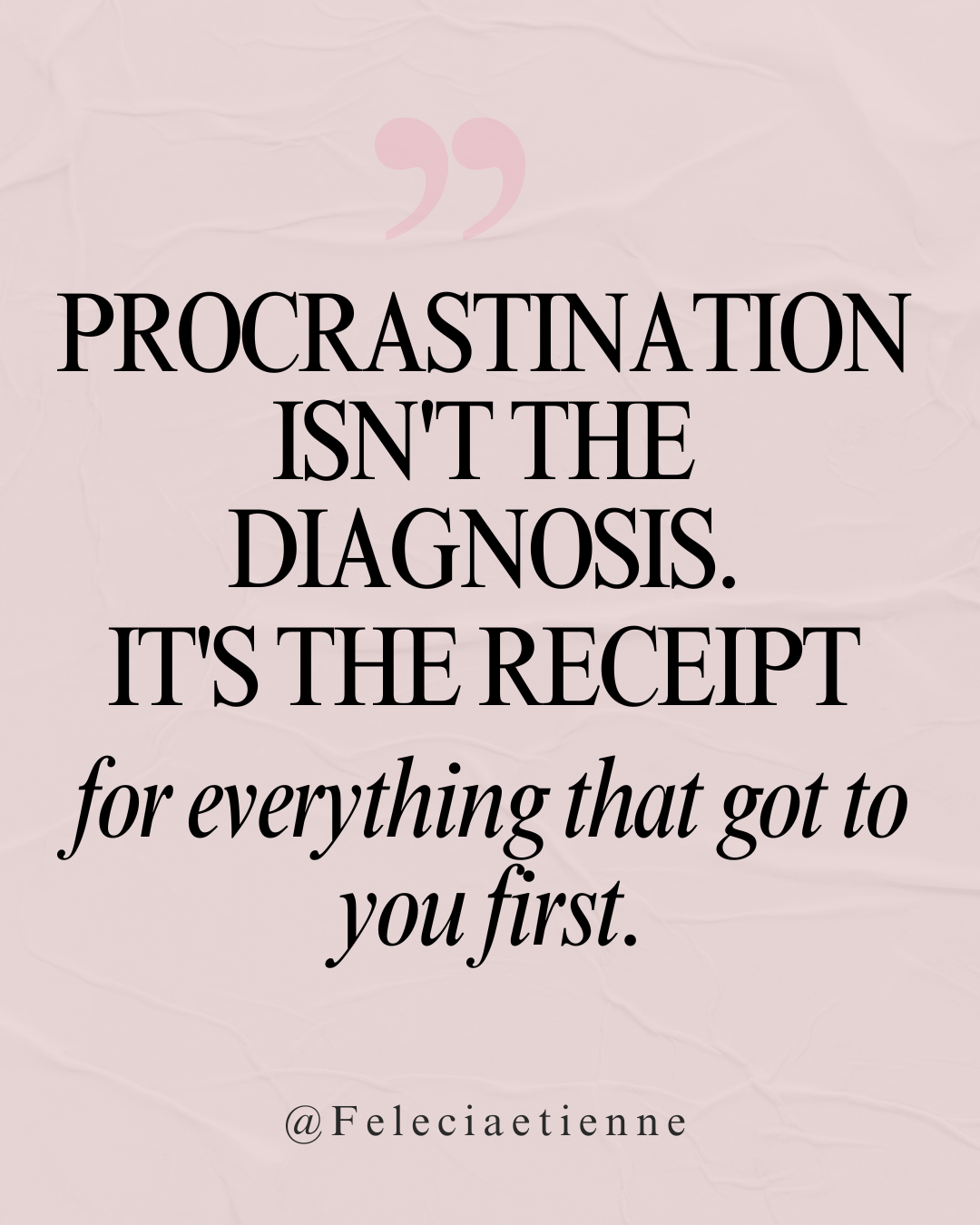
“Procrastination isn’t the diagnosis. It’s the receipt for everything that got to you first.”
Who Got to Your Week Before You Did?
Stop Making the Task a Verdict About You
When important work keeps moving, the first questions usually turn inward.
Why can’t I focus?
Why do I keep putting this off?
What is wrong with me that I cannot finish something I know matters?
Those questions make the task feel like evidence about your character.
They also keep your attention fixed on the final moment, when the proposal stayed open, instead of the hours that came before it.
A more useful place to look is the week itself.
Who received your attention first?
What kept entering the day without having to prove it belonged there?
What was already being carried by the time you reached the work you had planned to protect?
The Loud Things Got Access First
Think about how the day actually unfolded.
The client request was answered first. The team question interrupted the block you had protected. An issue with enough noise around it was treated as urgent, even though it could have waited.
The proposal did not arrive with a notification.
It sat quietly where you left it.
Important work often loses for that reason. It rarely interrupts you. It waits for you to return with enough focus to move it.
And unless the week is built to protect that return, whatever is loudest keeps going first.
Discipline Cannot Fix an Access Problem
When other people’s questions, unfinished decisions, and reactive work repeatedly reach you before your own priorities do, discipline becomes the tool you use to compensate.
You try to force the proposal into whatever is left.
One more hour. One more push. One more promise that tomorrow you will protect the time better.
The problem is not that you are incapable of focusing.
The problem is that the work requiring your clearest thinking keeps receiving the most depleted version of you.
That is why a calendar can look organized while the week still feels reactive.
related article: The Clarity Collapse Cycle: The Hidden Burnout Loop That Looks Like High Performance
“You’re not avoiding the task. You’re avoiding what finishing it will force you to face.”

The Same Pattern Shows Up in More Than One Place
When the Business Gets First Access to You
Sometimes the pressure reaches you through the business.
Decisions that should be able to move without you still find their way back to your desk. The team waits for approval, clarification, rescue, or a quick opinion before taking the next step.
A new client comes in, and before the last piece of delivery is fully settled, your mind is already holding the follow-up, the next deadline, the team question, and three small approvals no one else experiences as costly.
So the proposal waits.
The hire waits.
The offer decision that could change how the business operates gets pushed behind whatever arrived in the inbox that morning.
The business may be growing, but too much of that growth is still being routed through you. That dependency becomes even clearer when you look at where you are still functioning as the system inside the business.
That changes what is available when you finally reach the work only you can do.
When Everyone Else’s Needs Get First Access to You
Sometimes the business is only part of what the week is asking you to carry.
You remember the appointment while brushing your teeth. The school form still needs to be signed. A family text creates another decision. Someone asks what is happening for dinner because the answer is assumed to live with you.
None of those moments looks large on its own.
Together, they keep part of your attention working in the background long before you sit down at the laptop.
The proposal is not only competing with other work.
It is competing with everything you have already remembered, answered, adjusted, and quietly kept from falling through.
By the time you reach it, choosing where to begin may require more effort than the calendar suggests it should.
The Unfinished Task Is Where the Truth Becomes Visible
This is why a better routine does not always hold.
The routine may account for the hour on the calendar. It may not account for what your mind and energy were already carrying into that hour.
The source of the pressure may look different.
In the business, it may be decisions and dependency.
In life, it may be invisible tracking, emotional labor, and needs that keep defaulting to you.
Either way, the important work receives what remains.
The unfinished task is often the first place that pattern becomes impossible to ignore.
Related Article: AI Isn’t Replacing Leadership. It’s Exposing Where You Are Still the System
The 4 Hidden Drivers Behind One Avoided Task
Before You Blame Procrastination, Look at What the Task Is Carrying
The proposal looks like one task until you try to do it.
On paper, the steps are simple. Open the document. Tighten the draft. Name the number. Send it.
But your brain is not responding only to the steps.
It is also responding to what may happen after you complete them.
The possible no.
The client’s reaction.
The number that makes your judgment visible.
The decision that becomes real once the proposal leaves your hands.
And the frustration of knowing this should have been finished already.
That is why “just start” can feel so disconnected from the actual experience.
The task is not arriving empty.
By the time you reach it, one or more of four hidden drivers may already be shaping the delay.
Driver 1: Emotional Weight
The quick email does not ask you to put your pricing, judgment, leadership, or reputation on the line.
The proposal does.
Before you touch the document, part of you may already be calculating the emotional risk.
What if the number feels too high?
What if they say no?
What if sending it exposes that I am not as ready as I thought?
You can spend the entire day close to the work without moving it. Answering messages. Clearing the inbox. Adjusting the format. Handling things that let you feel productive without requiring you to face the outcome.
Keeping the proposal open may feel safer than letting it be judged.
That is not laziness.
You are not only avoiding the task. You may be avoiding the emotional cost you expect to come with finishing it.
Research on procrastination has repeatedly connected delay with short-term mood repair. In plain language, people sometimes postpone a task because avoiding it offers temporary relief from the feelings attached to it.
Driver 2: Attention Residue
Even when the task itself does not feel emotionally risky, your focus may still be split.
A client call felt off, and part of your mind is replaying it. You gave someone a partial answer and know the conversation is not finished. A hiring decision, unread message, or problem you planned to revisit is still sitting open somewhere in the background.
None of it has to be loud to keep using attention.
That is what makes this driver difficult to notice. You may have moved on physically while part of your thinking is still attached to what came before.
So when you open the proposal at 9:47 p.m., the fog did not begin with the document.
Your attention had already been divided.
You did not suddenly lose focus that night. You never fully got it back from earlier in the day.
Driver 3: Capacity Debt
The same task can feel manageable in one season and almost impossible in another.
At first, you can push through a hard day and recover. You have probably done that for years.
But difficult days begin to accumulate when there is no real place for recovery.
A tense conversation. A week of poor sleep. A month of being the backup plan. Too many decisions that appear small until you count how often they require you to stop, think, adjust, or absorb the consequence.
Each one draws from the same limited supply.
Capacity works like a credit card. Small charges still count.
Keep spending without paying anything down, and eventually an ordinary task starts to feel expensive. That balance can keep growing even while you are still performing, which is why the cost of sustained pressure is often visible before high performers are willing to call it a problem.
By the time you reach the proposal, much of your decision-making energy may have already been used on choices no one else noticed.
What to answer.
What to fix yourself because explaining it feels harder.
What to let slide.
What to postpone because you cannot hold one more meaningful decision.
The proposal did not become more difficult.
You had less available for it.
That is compounding in the wrong direction.
Driver 4: Priority Protection Failure
This driver often looks like a scheduling problem.
You blocked the time. The proposal was on the list. The calendar may even show an open hour.
But the day was never truly built to protect the work.
The client request entered first. The team question interrupted the block. A quick approval took ten minutes, then another issue followed it. The smaller task offered an easy finish, so you handled that before opening the thing that required deeper thought.
The important work stayed quiet.
And quiet work often loses until the cost of delaying it becomes loud enough to create urgency.
That is Priority Protection Failure.
The task mattered, but nothing in the week required other demands to wait before taking the attention you meant to give it.
Important work cannot keep living on whatever remains after the day is done with you.
The difference between carrying the same task into another week and finally moving it is not always more willpower.
It is being able to see which driver is shaping the delay:
Emotional Weight.
Attention Residue.
Capacity Debt.
Priority Protection Failure.
Once you can name the driver, procrastination stops looking like a personal mystery.
It becomes information you can use.
“You’re not procrastinating. You’re carrying too many open loops at the same time.”

The Who Ran Your Week™ Reframe
An Organized Calendar Is Not Always a Self-Directed Week
A calendar can look completely under control and still give your priorities the least protected part of you.
The meetings fit. The tasks are organized. The important work has its own block.
Then the week begins.
A client request enters. A team decision comes back. The household logistics need an answer. The block you meant to protect becomes the easiest thing to move because it is not making noise or waiting for an immediate response.
By the end of the week, you have handled a lot.
The work you said mattered most is still open.
That is the distinction behind Who Ran Your Week™.
A full week and a self-directed week are not the same thing.
See What Has Been Deciding Your Week
The Who Ran Your Week™ Diagnostic helps you look at the week you actually had, not only the one you planned.
You will examine where your attention went first, which decisions kept returning to you, what stayed protected, and what became flexible as soon as someone else needed something.
The goal is not to prove that you need a better routine.
It is to see whether the important work was truly protected or repeatedly asked to survive on whatever remained.
The proposal at 9:47 p.m. is one piece of evidence.
So is the strategy block you keep moving, the decision you revisit without closing, and the priority that keeps receiving the most depleted part of your day.
Once those moments stop looking like separate failures, the pattern becomes easier to name.
Take the Who Ran Your Week™ Diagnostic to see what has been receiving first access to your time, attention, and decision-making energy.
Related article: The CEO Execution Framework: How to Stop Spinning Your Wheels & Start Scaling with Clarity
The Task Was Evidence, Not an Indictment
The proposal sitting open at 9:47 p.m. was not proof that you lacked discipline.
It showed you what received your attention first, what the week asked you to carry, and what remained when your own priority finally got a turn.
That difference matters.
You can use the unfinished task to build another case against yourself.
Or you can treat it as information.
Procrastination was the receipt.
Now you know to look at what the week had already charged before the important work reached you.
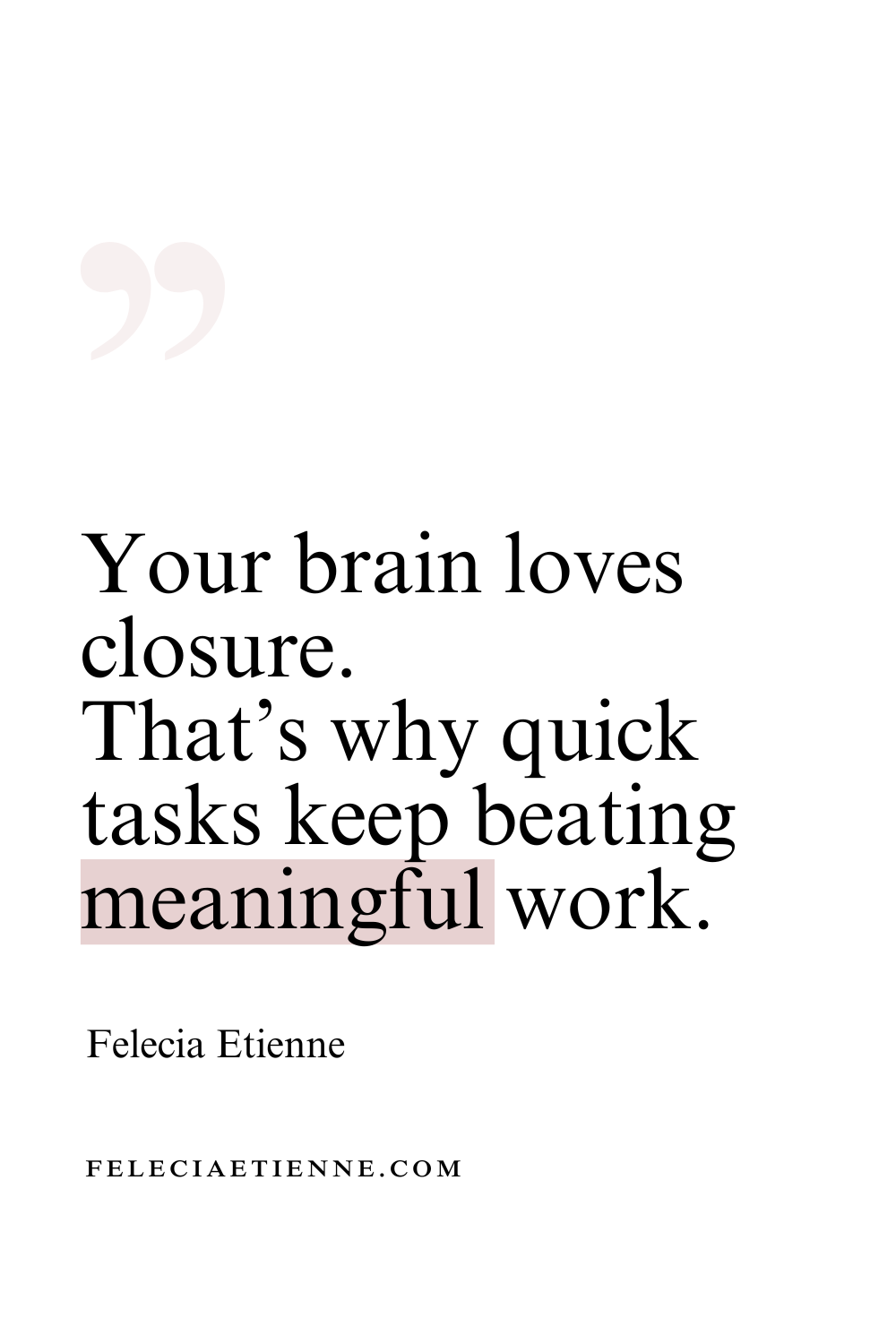
“Your brain loves closure. That’s why quick tasks keep beating meaningful work.”
Why Am I Procrastinating? Questions High Performers Are Actually Asking
Why Do I Procrastinate on the Things I Care About Most?
Low-stakes work gives you a quick finish. Important work often makes something real.
Clearing an email or scheduling a meeting rarely puts much at risk. A proposal, application, hiring decision, offer change, or meaningful creative project may expose your judgment, pricing, leadership, or readiness to be evaluated.
That changes the emotional cost of finishing.
A no may feel personal. Naming the number may bring up doubt. Completing the work may force a decision you have been able to postpone while it remained unfinished.
So the easier tasks go first. They offer relief without requiring you to face the outcome that matters more.
That does not mean you care less about the important work.
Sometimes you delay it precisely because it carries more meaning.
A useful question is:
What becomes real once I finish this?
Is Procrastination a Sign of a Mental Health Issue?
Procrastination by itself is not a diagnosis.
People delay tasks for many reasons. A task may bring up discomfort or uncertainty. Attention may already be divided. Exhaustion, unclear decisions, excessive responsibility, or a lack of support can also make beginning and following through more difficult.
This article focuses on those common patterns. It cannot explain every reason someone may be struggling.
When avoidance is persistent, causes significant distress, interferes with daily life, or appears alongside ongoing anxiety, low mood, or other concerning changes, speaking with a qualified health professional may be appropriate.
An unfinished task should not automatically become a diagnosis.
It should not become a judgment about your character either.
Why Doesn’t More Discipline Fix My Procrastination?
Discipline can help you begin a task.
It cannot repeatedly compensate for a week that gives important work the least protected part of your attention.
You may push through the proposal tonight. But if tomorrow’s priorities are displaced by the same interruptions and demands, the pattern will return with a different task.
That is why a new planner, earlier alarm, or stricter routine may help briefly and then stop holding.
The tool changed.
The conditions surrounding the work did not.
More discipline may help you override the delay once. It does not explain why the work keeps requiring rescue.
Why Do I Procrastinate More When I’m Already Overwhelmed?
Starting requires more than an open hour.
You can have time on the calendar and still struggle to focus because part of your mind is replaying a conversation, holding an unresolved decision, or trying not to forget what still needs your attention.
Overwhelm reduces what is available for the task in front of you.
The work may not be harder than it was a month ago. You may simply be arriving with more unfinished business and less room to think.
Pushing harder can move one task across the line.
It can also leave you with even less capacity for the next one.
That is why overwhelm and procrastination often appear together. The delay is easy to see. The load that came before it is easier to miss.
What’s the Difference Between Procrastination and Having Too Much on My Plate?
Procrastination describes the delay.
Having too much on your plate may be one reason the delay keeps happening.
Sometimes the total load is genuinely more than one person can reasonably carry. There are too many responsibilities, too many decisions, and too little time, recovery, or support.
In other situations, there may appear to be enough space, but reactive demands keep taking it before the important work begins.
Both situations can leave the same visible result: the priority remains unfinished.
But they do not require exactly the same response.
One may require reducing or redistributing the load. The other may require changing what is allowed to interrupt, displace, or consume the time you meant to protect.
Many weeks contain both.
The Who Ran Your Week™ Diagnostic helps you examine that difference using the week you actually lived, not only the one shown on your calendar.
Related article: The Performance Trap: Why High Achievers Burn Out Even When They’re Doing Everything "Right"
Felecia Etienne is the founder of The Aligned Advantage™, where she helps high-achieving founders, leaders, and professionals replace pressure-led performance with clear, sustainable execution.
To find out more about Felecia, you can visit her website at feleciaetienne.com.
Social Media Handles: