You’re Productive Every Day. So Why Is Your Most Important Work Still Sitting There?
The Lie of the Productive Morning
Sometimes, things can feel a bit too polished, like they’re trying too hard. That’s often when people sense that something isn’t quite right.
When people write, their work shows personality. It loops back, gets a bit messy, and sometimes notices things in unexpected ways instead of presenting everything perfectly.
You’ve probably had mornings like this.
Calendar open. Coffee next to the laptop. One real block of time finally protected.
And sitting there is the thing that actually matters.
The proposal. The strategic deck. The offer revision. The decision you’ve been carrying around for three weeks. The thing that changes the trajectory if you actually finish it.
You open the document.
Read the first few lines.
Maybe even adjust the font for no reason.
You’re finally about to get into it.
Then Slack pings.
A quick question. A client follow-up. Something operational. Something technically small.
You answer because it’ll take thirty seconds.
Then you check email while you’re there. Then your calendar. Then, another message you forgot to respond to yesterday.
And somehow it’s 8:47.
Which is always slightly annoying because it felt like ten minutes.
You click back into the document, and the thread is gone.
Not the task. The thread.
The internal momentum. The sentence you were building toward. The clarity that was there twenty minutes ago.
Now you’re rereading paragraphs, trying to get yourself back into it.
And if we’re being real, sometimes you never fully do.
The work stays open all day. You touch it three more times. Maybe five.
But nothing actually moves.
That’s the part people miss.
Most high performers are working constantly. That’s almost never the issue.
It’s that the wrong things keep eating the best parts of the day.
And after a while, you stop trusting your own priorities because everything around you feels more immediate.
And honestly, calling this procrastination has never fully felt accurate to me.
Procrastination sounds passive, but this kind of delay often looks responsible as it happens.
This happens when urgency starts guiding your decisions by default.
That’s Priority Displacement.
Once you notice this pattern, you begin to spot it everywhere..
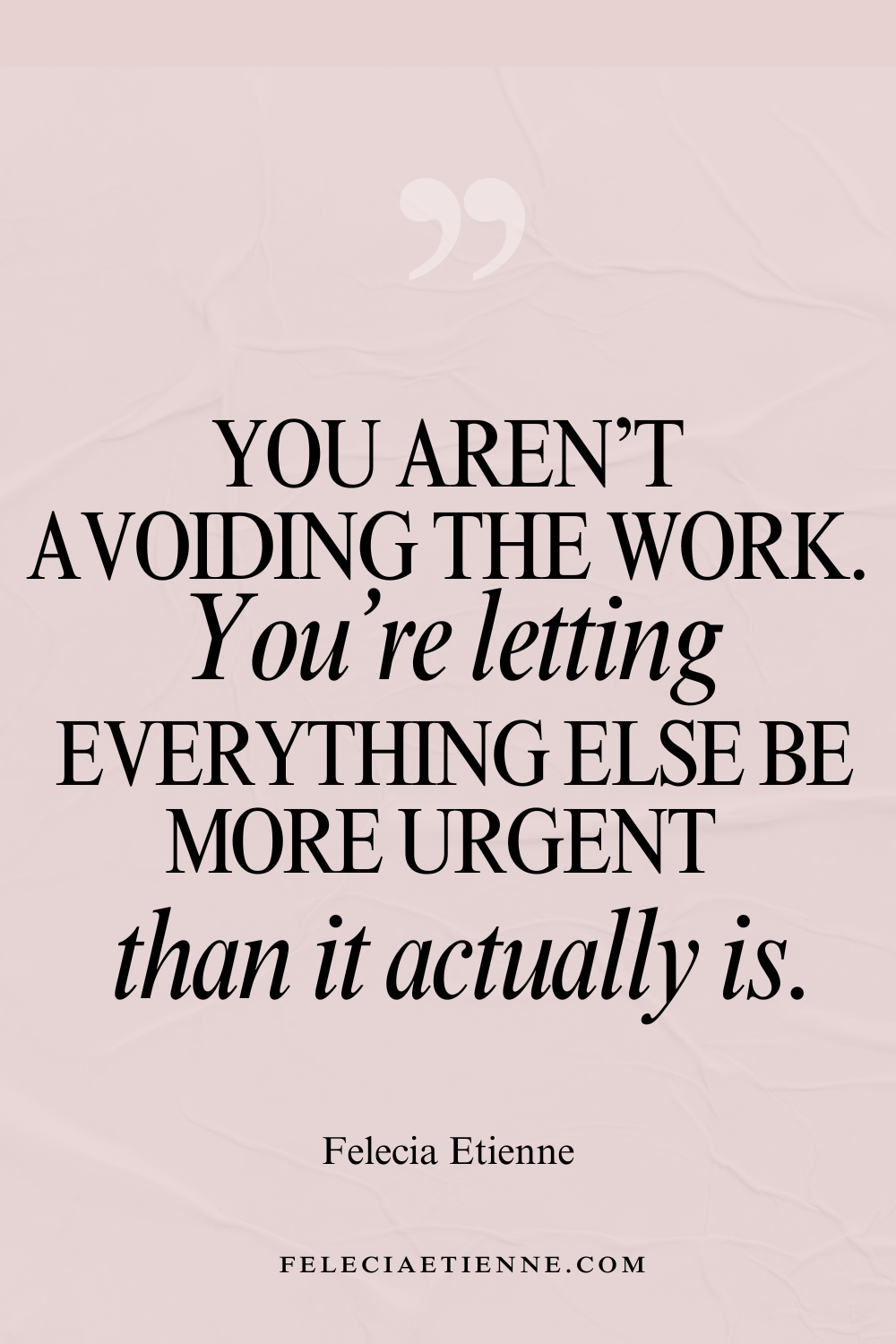
“You aren’t avoiding the work. You’re letting everything else be more urgent than it actually is.”
You’re Not Avoiding the Work. You’re Letting Everything Else Interrupt It.
Avoidance is obvious.
You know when you’re avoiding something. The tab is open, and you keep clicking away from it. You keep telling yourself you’ll come back when you’re “more focused.”
Priority Displacement is harder to catch because the interruptions all look responsible.
That’s what makes it dangerous.
The Slack message matters. That’s the problem.
Your team member probably does need an answer. The client follow-up matters too. The invoice should get handled.
None of this is fake urgency.
None of these things looks irrational in the moment.
That’s why productive people stay trapped in this pattern for years.
Because the day still looks successful from the outside.
You answered things. You moved things. You handled things.
But the one piece of work that would actually change the business keeps getting moved to tomorrow.
Then tomorrow becomes next week.
Then you start carrying the psychological weight of unfinished strategic work everywhere.
That’s what really wears you out.
Not the workload. The constant cognitive drag of things that matter, staying open.
Your brain holds unfinished priorities differently than completed ones.
Open loops keep consuming attention in the background. Even when you’re technically doing something else.
So now you’re answering emails while mentally carrying:
The launch you haven’t finished. The system you still need to build. The offer revision you keep postponing. The hiring decision sitting in the back of your mind.
That isn’t true productivity. It’s your attention getting scattered.
Eventually, your whole workday can feel like you’re moving but not making real progress.
You’re not behind because you’re lazy. You’re behind because your attention keeps getting reassigned in real time.
related article: The Clarity Collapse Cycle: The Hidden Burnout Loop That Looks Like High Performance
“You move the block to protect your old self-concept at the expense of your revenue target.”

The Pattern Most High Performers Defend
This is the part that gets protected.
Not intentionally. But constantly.
Because this behavior often looks like competence.
You’re responsive. Reliable. Helpful. Available.
You answer quickly. You step in fast. You keep things moving.
And for a while, those behaviors genuinely help you succeed.
Especially early.
Being the person who handles things quickly gets rewarded. People trust you. Clients rely on you. Teams depend on you.
So the pattern gets reinforced.
Then eventually something shifts.
As your business grows, responsibilities increase and decisions become more important. Suddenly, the quick responses that once helped you move forward now start to hurt your focus.
But because you’re still capable, nobody notices the cost yet.
Including you.
That’s the trap.
People think collapse looks dramatic. Most of the time it doesn’t.
It looks like becoming increasingly unavailable for the things you said mattered most.
One interruption at a time.
Why Small Tasks Keep Winning
This part matters because most people misdiagnose themselves here.
Your brain is wired to reward completion. Not importance.
That quick email response gives your nervous system a sense of closure. Same with checking something off. Same with answering a message. Same with resolving a tiny decision.
The reward is immediate. The feedback is immediate. The completion is visible.
Strategic work doesn’t work like that.
The payoff is delayed. Messy. Uncertain.
Sometimes you work on something important for two hours and there’s still no satisfying sense of completion yet.
So your brain starts pulling toward the thing that feels easier to close.
Not because you lack discipline. Because your nervous system prefers certainty.
That’s why so many mornings start the same way.
You tell yourself:
“I’ll clear a few things first.”
And honestly, it feels reasonable.
You want to feel caught up before you focus. You want the noise reduced. You want the inbox calmer.
But the problem is the clearing never ends.
There’s always another message. Another decision. Another thing someone needs.
And by the time the reactive work slows down, the best cognitive window is gone.
That sharp morning clarity? Spent.
The focus you needed for the important work already got consumed by micro-decisions.
That’s why people keep saying they “work all day” but still feel disconnected from what actually matters.
Because the day got consumed by reaction before authorship ever had a chance.
Urgency keeps winning your attention before intention does.
Related Article: The Ambition Contract: The Hidden Rules High Achievers Never Agreed To
The Fixer Identity Quietly Becomes a Leadership Problem
And this is usually where the conversation stops being about productivity at all.
At some point, it becomes identity.
You become known as the reliable one. The one who responds. The one who handles things. The one people can count on.
And if we’re being honest, there’s usually history attached to that.
A lot of high performers built safety around usefulness.
Being dependable became part of who you are. Maybe even part of how you earned approval.
So now when someone needs something from you, your nervous system reads responsiveness as responsibility.
Even when responding immediately costs you something bigger.
That’s why strategic work gets displaced so easily.
Because the strategic work usually doesn’t create immediate relational pressure.
Nobody’s waiting on the other side of the Google Doc.
But someone is waiting on Slack. Someone is waiting in email. Someone is waiting for an answer.
So the nervous system prioritizes the visible request.
Not the invisible future impact.
This is where a lot of founders unknowingly stay trapped in what I call the Fixer role.
The Fixer keeps everything moving personally. The Architect builds systems that move without constant personal intervention.
Those are different jobs.
And eventually, you have to choose which one you’re actually operating from.
Because the business cannot scale while your attention stays emotionally available to every interruption.
The Fixer is loved because they relieve pressure in real time.
The Architect changes the structure, creating the pressure in the first place.
That’s a different level of leadership.
“You’re not procrastinating. You’re carrying too many open loops at the same time.”

The Cost Starts Compounding Quietly
What makes this hard to catch is that the pattern still gets rewarded for a long time.
Especially when revenue still looks okay.
Because the tax rarely shows up immediately.
It compounds.
First, you lose clarity.
You start re-deciding the same priorities over and over because nothing stays protected long enough to fully move.
Then energy starts draining.
Simple work feels heavier than it should. You need pressure to focus. Deadlines become the only thing strong enough to cut through the noise.
Then time disappears.
Your calendar becomes full of things that technically matter but never actually create leverage.
And eventually ownership starts eroding.
This is the part most people don’t say out loud.
You’re still keeping promises to clients. Still showing up for your team. Still handling responsibilities.
But privately?
You keep breaking promises to yourself.
The strategy block gets moved. The workout gets postponed. The thinking time disappears. The important project rolls into another week.
And after a while, you stop fully believing yourself when you say something matters.
That’s the Ownership Tax.
Not because you don’t care. Because your environment keeps training you to abandon your own priorities first.
And once that pattern normalizes, the business starts organizing itself around your reactivity.
Your team learns to wait. Everything routes back through you. Decision-making slows. People stop taking ownership because they’ve learned you’ll step in anyway.
Then one day, you look around and realize nothing really moves unless you touch it.
Not because your team is incapable. Because the system trained dependency.
Related article: The CEO Execution Framework: How to Stop Spinning Your Wheels & Start Scaling with Clarity
This Isn’t a Planner Problem
Most people respond by tightening the system.
New planner. Different app. Fresh calendar setup. Color coding. Whatever version of control feels possible that week.
Another planner. Another app. Another productivity system.
But Priority Displacement is rarely a tool problem.
It’s a protection problem.
Because if your highest-value work stays emotionally negotiable, reactive work will keep consuming the space.
Every time.
The people who consistently move strategic work forward usually aren’t more disciplined.
They’ve simply removed negotiation from the environment.
Their thinking time is protected before the day gets noisy. The work is already loaded. The decision was already made. The distractions are structurally harder to access.
That matters more than motivation ever will.
Because once the workday starts reacting, most people never fully recover the thread.
Attention residue is real.
Every interruption leaves part of your focus behind.
So when you spend the first ninety minutes of the day bouncing between Slack, email, texts, approvals, and micro-decisions, your brain doesn’t magically snap back into deep strategic thinking afterward.
It keeps carrying fragments of everything it already touched.
That’s why the important work suddenly feels harder to enter.
Not because you became incapable in two hours. Because your cognitive bandwidth already got divided fifteen different ways.
The Work Is Still There Because the Structure Keeps Sacrificing It
Your most important work is probably not unfinished because you don’t care.
It’s unfinished because the current structure of your day keeps rewarding interruption over authorship.
And when that pattern repeats long enough, urgency starts masquerading as leadership.
But responsiveness is not the same thing as direction.
At some point, leadership requires protecting what matters before the world starts pulling at you.
That’s the shift.
Not becoming less responsible. Becoming more deliberate about what your attention is actually funding.
Because right now, your attention is building something.
The question is whether it’s building momentum. Or dependency.
And if the work that matters most keeps getting displaced, the business eventually feels heavier, no matter how successful it looks from the outside.
Not because you’re failing.
Because the system underneath your success was never designed to protect depth.
That’s a design problem.
And design problems can be rebuilt.
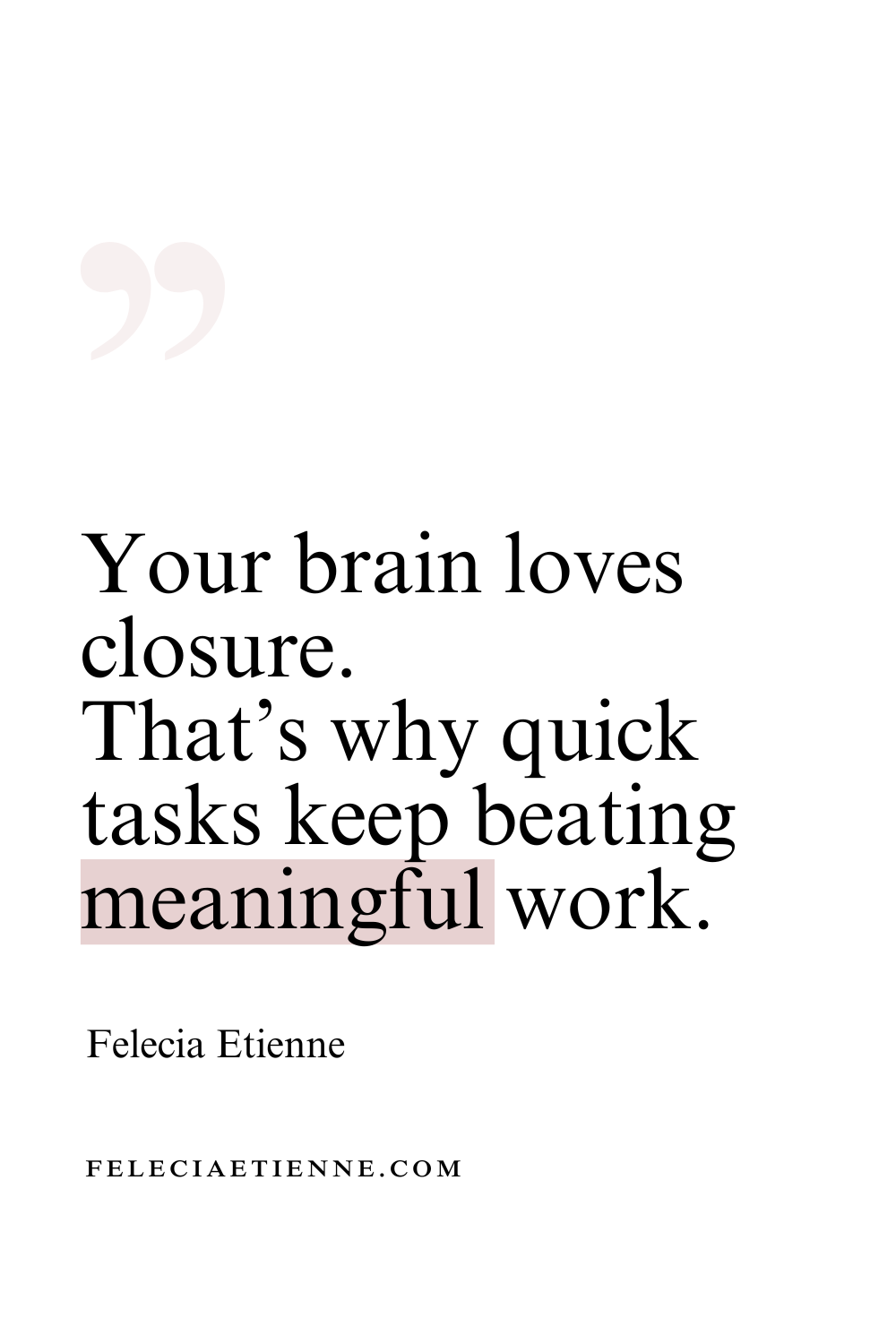
“Your brain loves closure. That’s why quick tasks keep beating meaningful work.”
Frequently Asked Questions
Why do I procrastinate on important work even when I care about it?
A lot of high performers assume they’re procrastinating when they’re actually dealing with Priority Displacement. The important work keeps losing to reactive work that feels more immediate in the moment. Your nervous system responds faster to visible urgency than to delayed strategic payoff. That’s not laziness. It’s a structural attention problem.
Why does urgent work always feel easier to complete?
Urgent work creates immediate closure. Emails, messages, approvals, and quick decisions give your brain fast feedback. Strategic work usually requires sustained focus before you feel progress. That gap is where most important work keeps getting interrupted.
Why do I feel productive all day but still behind?
Because productivity and strategic movement are not the same thing. You can complete dozens of tasks while still avoiding the work that actually changes the business. Motion and traction are different experiences.
What is Priority Displacement?
Priority Displacement is when important work consistently gets moved by reactive work that appears legitimate in real time. Nothing feels irresponsible individually, but over time, the strategic priorities never stay protected long enough to fully move.
Why do successful founders struggle with focus?
At higher levels, focus problems are rarely about capability. They’re usually about cognitive fragmentation. Too many decisions, interruptions, and unresolved priorities divide attention across the day until deep work becomes difficult to sustain.
Why does everything in my business still feel dependent on me?
Because responsiveness trains dependency faster than most leaders realize. When founders repeatedly step in, answer everything quickly, or become the center of decision-making, the business slowly organizes itself around their availability instead of clear operational ownership.
The Real Shift
You do not need to become less ambitious.
You probably need to stop letting reactive work consume the energy required for the things that actually matter.
Because eventually, the cost isn’t the unfinished project.
It’s the relationship you start developing with your own priorities.
And once that starts eroding, success gets heavier than it should.
Not all at once. Quietly.
One interruption at a time.
Related article: The Performance Trap: Why High Achievers Burn Out Even When They’re Doing Everything "Right"
Supermom Summer Camp
Feeling like summer break just started and you’re already overwhelmed? Been there. That’s exactly why I’ll be at Supermom Summer Camp. It’s a free 5-day virtual event for busy moms who want more calm, more clarity, and way less chaos. From June 8th to 12th, you’ll get daily prompts, live sessions, and fun ways to finally start doing less while getting more done. It’s like summer camp, but for moms and you don’t even have to pack a backpack. Save your spot at the link in the show notes!


P.S. If you're looking for deeper support as you navigate this transformative journey, here are two ways I can help:
Master Your Mindset: I specialize in helping high achievers, business owners, and professionals break into the top 1% of their field by mastering their mindset and boosting their performance. When you're ready to take your success to the next level, DM me the word "Edge," and let's start that conversation.
Free Resource for Change: Don’t let negative emotions hold you back! Grab my Self-Sabotage Solution Checklist: a free tool designed to help you identify and release the limiting beliefs that no longer serve you. Take the first step toward a more empowered you today!
Embrace this opportunity to shift from burnout to brilliance. Your path to sustainable success starts now!
Ready to achieve your dream life? I’m Felecia Etienne, your go-to Certified High-Performance Coach™ and Mental Fitness Coach. Let me take you on a transformative journey with a Complimentary Unlock Your Performance EDGE call. This isn’t just a chat, it’s your ticket to the high-performance tools and techniques I’ve shared with my coaching clients.
In this personalized call, you'll:
- Dive into your dreams and goals, tackle obstacles, and bridge the gap between where you are and where you want to be.
- Uncover and combat triggers of self-sabotage while discovering untapped strengths.
- You'll walk away with actionable strategies that deliver immediate impact
Equip yourself with the strategies, resources, and support needed to shatter obstacles, self-sabotaging, narrow the gap, and transform your ambitions into tangible achievements. Ready to escape inertia and boost your impact? Book a private and confidential session. Unlock Your Performance EDGE with Felecia. Let's unlock your potential together.
To find out more about Felecia, you can visit her website at feleciaetienne.com.
Social Media Handles:
Feeling stuck and unfulfilled? It's time to break free from self-sabotage!
Download our Self-Sabotage Solution Checklist and
start your journey to personal mastery today.