Why You’re Ending the Year Exhausted (Even When You ‘Did Everything Right’)
The Year-End That Looks Like Success… and Feels Like Collapse
Let's get real for a moment:
On paper, this year is a triumph. You crushed your targets, navigated every storm, and were the rock for everyone around you. Your checklist is a mile long, and you've ticked off boxes you didn't even know existed. To the world, you're the definition of success.
But here's the truth behind the curtain:
You're parked outside Target, staring blankly at emails you've read a dozen times, your brain stuck in a loop.
You're skipping the very appointments that keep you sane: therapy, workouts, even that long-overdue haircut, because the pre-holiday rush feels like a tidal wave. It's 9:17 p.m., and you're "just checking one thing" on your laptop, only to find yourself drowning in tasks you can't even remember starting.
From the outside, it looks like you're on fire. Inside, you're running on empty, caught in a cycle of autopilot and resentment. You hit the milestones, but they feel hollow. You try to relax, but your mind is a relentless machine. You're not slowing down; you're stuck in a loop.
And the harshest truth?
The self-doubt that whispers when no one's listening:
"I should be better at this."
"Others have it worse."
"Why am I lagging when I'm ahead?"
"I know better. Why am I still here?"
You're not just exhausted. You're exhausted and silently blaming yourself for it.
Here’s the truth bomb that most high achievers never hear:
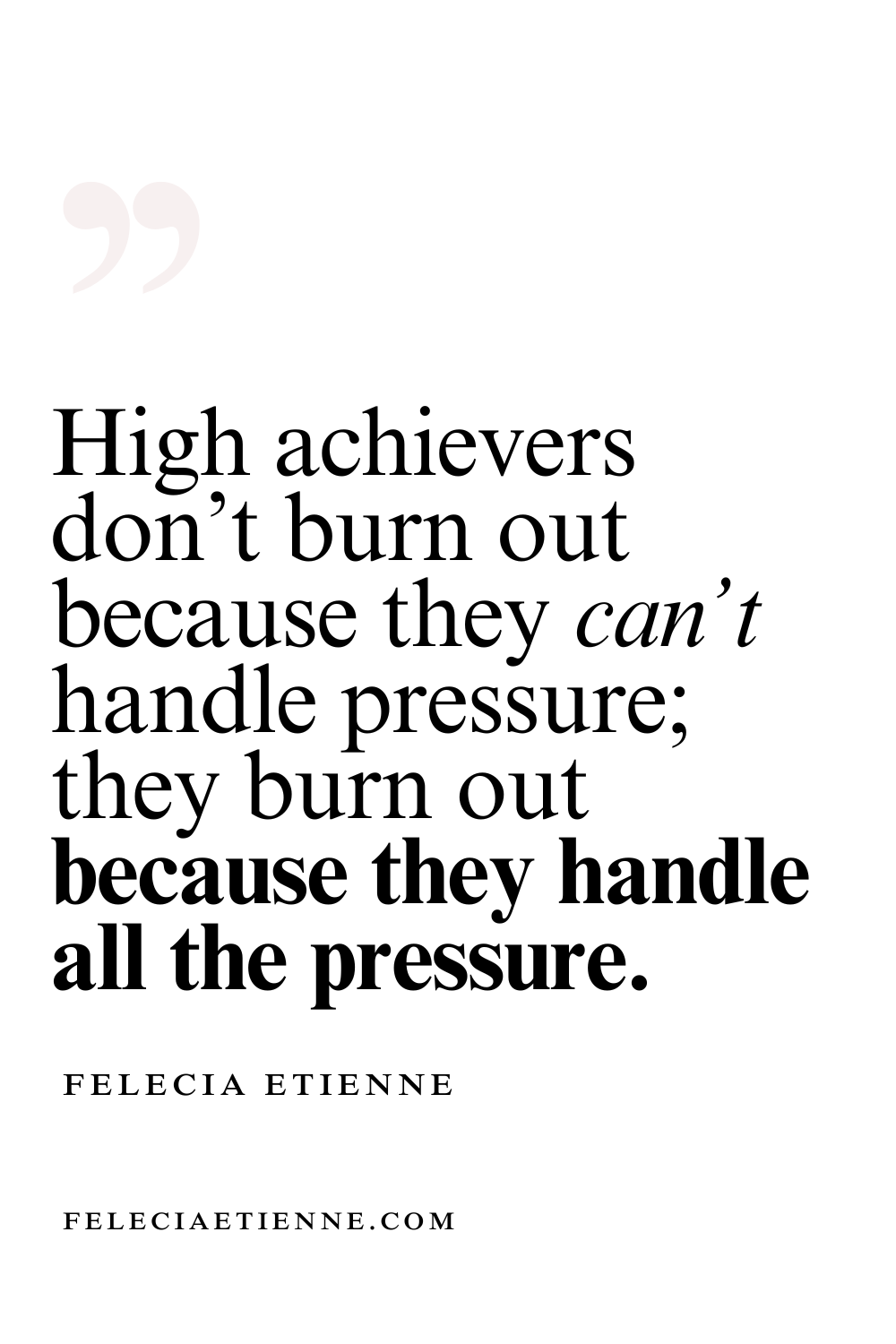
“High achievers don’t burn out because they can’t handle pressure; they burn out because they handle all the pressure.”
You’re not ending the year exhausted because you failed. You’re ending the year exhausted because your nervous system has been running a marathon on sprint settings… for twelve straight months.
Let’s break it down with some simple science:
When stress stays elevated for too long, your survival brain takes the wheel, and your prefrontal cortex, the part of your brain responsible for clarity, planning, and decision-making, dims. That’s why you’re staring at your to-do list and doing nothing.
That’s why you’re snapping at your kids, your partner, or even your calendar… then apologizing and blaming it on “being tired.” That’s why tasks that used to take 10 minutes now feel like a 10-mile hike.
Your brain isn’t broken. Your ambition isn’t broken. Your discipline isn’t broken. You’re simply operating with an overloaded internal operating system, an ambition that outpaced your bandwidth.
And yes, you can keep pushing through it. You’ve done it before. You’re good at it, too good.
But here’s what I want you to hear with compassion and clarity:
Not because you’re weak. Not because you’re behind. Not because you “should be able to handle it.” But because your body has been working overtime to keep you alive in a life that keeps demanding more.
That’s the real reason you feel like this.
👋🏾 New here?
Welcome to The Aligned Advantage™, the space where success is sustainable, ambition is regulated, and burnout doesn’t get the final say.
I’m Felecia Etienne, MBA, CHPC; former corporate executive turned High-Performance Coach, Mental Fitness, Business and Life Strategist, and creator of the C.E.O.™ Framework.
I help ambitious women rebuild their clarity, energy, and ownership so they can lead with power, without burning out their brilliance. I don’t teach high achievers how to squeeze more out of themselves. I teach them how to lead in a way their nervous system can actually sustain.
The Real Reason You’re Crawling to the Finish Line
By now, you’ve probably told yourself some version of: “It’s just a busy season. Once I get through the holidays, it’ll calm down.” You’ve blamed your exhaustion on your schedule, your industry, Q4, your kids’ school calendar, the travel, the “one last push” before year-end.
On the surface, it looks like a time problem: too many commitments, not enough hours. But underneath, it’s something else.
Accumulated Micro-Stress vs. One Big Crash
You didn’t run one 26-mile race this year. You ran twelve back-to-back 5Ks with no real recovery… and then told yourself to “finish strong” like that was a sustainable plan.
Think about the last few months:
The “Let’s get this done before the holidays” project, your team suddenly decided was urgent.
The performance reviews, the year-end targets, the metrics everyone’s quietly judging themselves against. The client who says, “Could we just squeeze in one more call before the break?” (You say yes, because “it’ll only take 30 minutes,” and it never does.)
None of those moments, on their own, feel like a crisis. But every time you say “sure, I’ll take it,” your system absorbs one more hit: One more deadline to hold in your head.
One more conversation to emotionally manage. One more commitment that steals from your future energy.
You keep telling yourself, “I can handle it.” And you can. That’s the problem. You’ve handled so much, for so long, that your body quietly stopped asking for permission and went straight into emergency mode as a default setting.
related article: Are You Emotionally Exhausted? 16 Warning Signs You Need a Mental Break
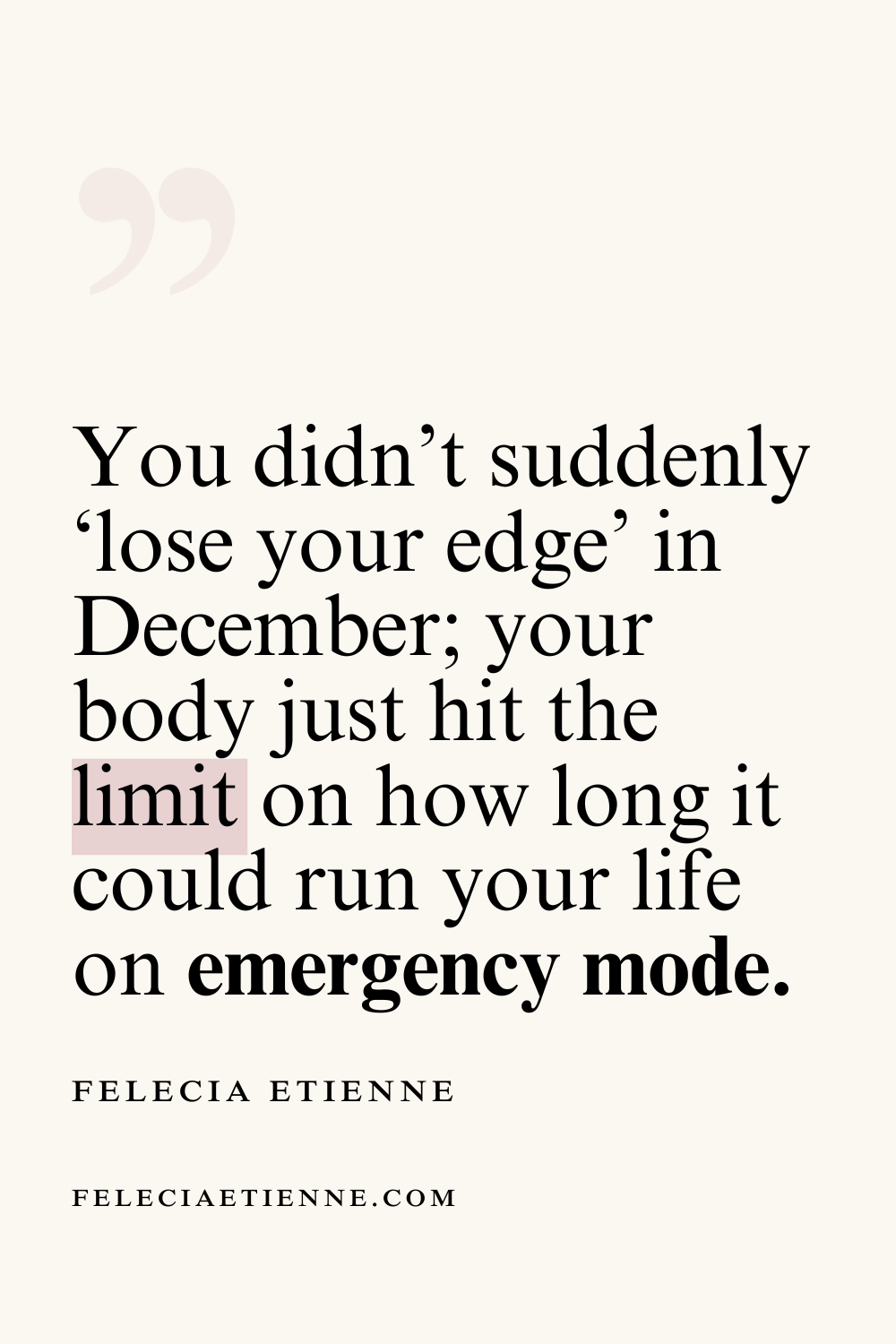
“You didn’t suddenly ‘lose your edge’ in December; your body just hit the limit on how long it could run your life on emergency mode.”
From the outside, it looks like you’re dragging at the finish line. On the inside, this is what it feels like when twelve months of micro-stress finally add up.
The Holiday + Year-End Stack (The Invisible Load)
And then… the holidays arrive. Not a break. A second shift. On top of closing loops, leading teams, hitting targets, and being the dependable one at work, you’re now:
Tracking gifts, budgets, and shipping cutoffs. Coordinating travel or hosting logistics. Managing family dynamics and unspoken expectations. Showing up at kids’ concerts, school events, church programs, office parties, usually with snacks, a gift, or emotional support in hand.
Your calendar only shows the meetings. It doesn’t show: The mental list you’re running in the shower. The emotional labor of trying to keep everyone else happy. The way you silently take on extra tasks so it’s “easier for everyone else.”
You say, “I’ll just do it; it’s faster if I handle it.” And it is… for everyone but you. Pretty soon, you’re carrying two full-time roles: The high-capacity, high-performing leader. The default project manager of everyone’s holiday experience.
No wonder your energy feels like it’s leaking from every corner. “I’ll make it easier for everyone else,” sounds noble. “No one sees how much I’m carrying,” feels lonely. That gap? That’s the invisible load.
The High-Achiever Rulebook Behind It All
Here’s the piece most people never question:
You’re not just tired because life is busy. You’re tired because of the rules you’ve been quietly living by.
Rules like:
“Rest is for when everything is done.”
“It’s just a busy season.” (You’ve used that line every quarter.)
“If I can do it, I should do it.” “It’s easier if I just handle it myself.”
You didn’t write those rules on paper. You wrote them in how you live. You became the go-to person, the fixer, the glue. The one who can handle it. The one who holds it together. The one everyone counts on. So now, even the thought of stepping back feels dangerous, like if you pause, everything and everyone might fall apart.
On some level, exhaustion has become proof: If you’re maxed out, you must be doing enough. If you’re stretched thin, you must be valuable. If you’re constantly “on,” you must be needed.
“You’re not overbooked because you love chaos. You’re overbooked because somewhere along the line, exhaustion became your proof that you’re enough.”
This isn’t just about December. This is the operating system you’ve been running all year. And your nervous system is waving a quiet red flag, asking a different question: “How much longer are we going to live like this?”
WHAT END-OF-YEAR EXHAUSTION REALLY LOOKS LIKE (THAT YOU’VE BEEN IGNORING)
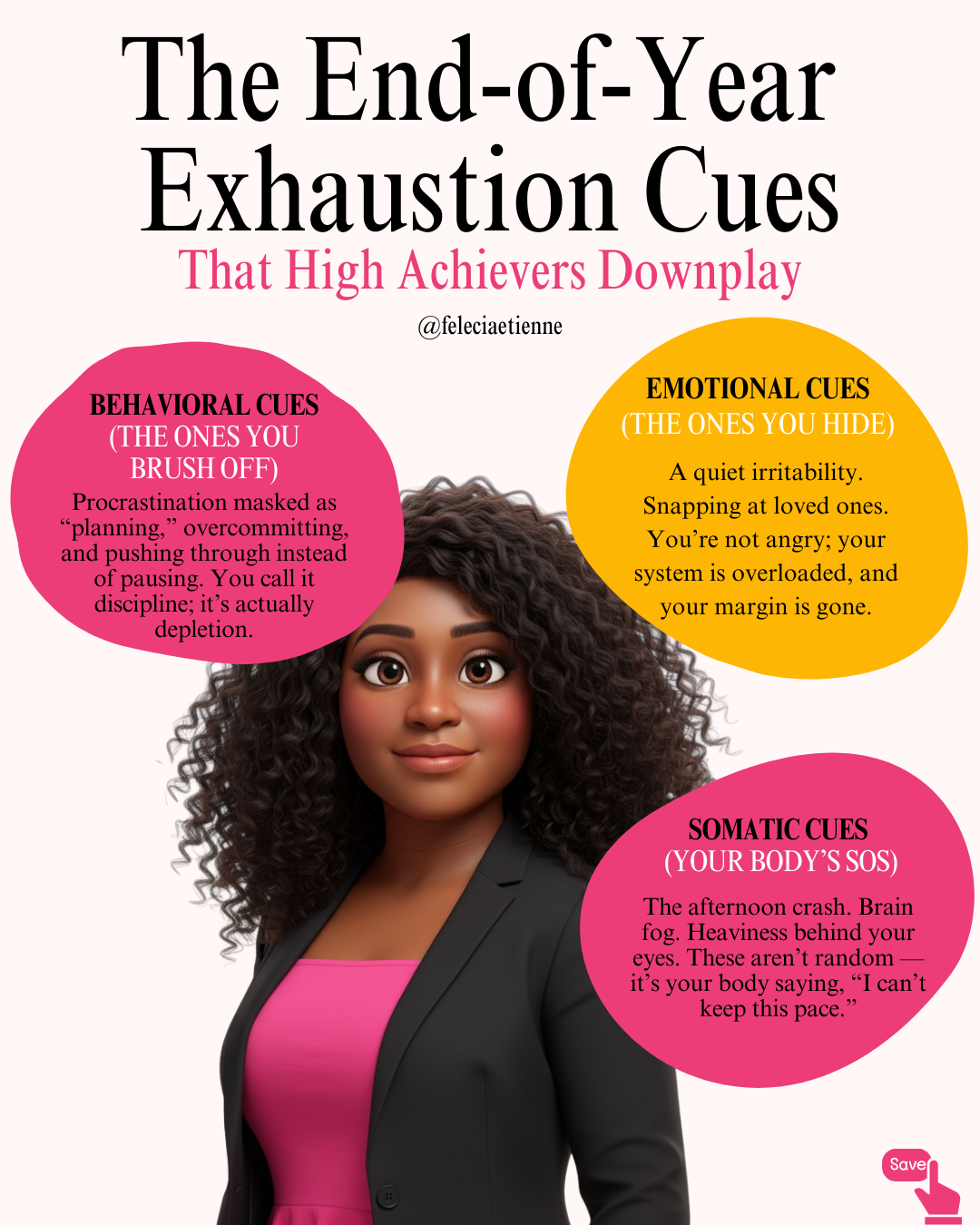
Let’s be real for a second. Burnout doesn’t announce itself with a crash. It sneaks in quietly, like a glitch in your system. You don’t fall apart, you just start feeling off. And because you’re used to carrying heavy loads alone, you brush it off as “just stress” or “just the holidays.” But these aren’t random moments. They’re your body’s way of waving a red flag.
Behavioral Cues (The Ones You Brush Off)
You open your laptop at 9:04 p.m. to check one thing, and suddenly it’s 10:27. You’re juggling five tabs: email, Asana, Google Docs, your bank account, your kid’s school portal, and finishing none. Saying yes to “just one more” task feels easier than saying no. These aren’t productivity issues, they’re signs your bandwidth is maxed out.
Emotional Cues (The Ones You Hide)
There’s a low hum of irritability. Not anger, just an edge. You snap at loved ones, not because you want to, but because you’re overwhelmed. You love them, but the invisible labor is drowning you. Then there’s the hollow feeling when you hit a milestone and feel nothing. It’s not ingratitude, it’s emotional depletion.
Somatic Cues (Your Body’s SOS)
Wired-but-tired every night, your brain scanning for fires. The Sunday dread isn’t about work, it’s about carrying too much. The afternoon crash hits like clockwork, making you want to escape. These aren’t random, they’re your body saying, “I can’t keep this pace.”
“Burnout rarely shows up as ‘I can’t do this.’ For high achievers, it shows up as ‘I’m doing everything… and feeling less and less like myself.’”
THIS ISN’T A TIME-MANAGEMENT PROBLEM. IT’S A NERVOUS SYSTEM LOAD PROBLEM.
Let’s have an honest moment between us: It’s not about having too little time. It’s about carrying too much. You’ve got the planner, the color-coded calendar, and the productivity hacks. Yet, you still feel like you’re running on a treadmill, never quite catching up. Sound familiar? You wake up bracing for impact, your chest tightens at the sight of your inbox, and by the end of the day, you wonder, “How did I stay busy all day and still feel stuck?”
Here’s the truth no one tells high achievers:
“If your body is in constant brace-for-impact mode, no planner can save you.”
You can’t out-organize a nervous system that’s on high alert. It’s not weakness, it’s survival instinct. Right now, your survival system is drowning out your strategy.
related article: The Ambition Loop: Why You Keep Crashing After Every Win (and How to Break It)
What Your Brain Actually Does Under Chronic Stress
Let’s simplify it:
Your brain has two modes. Survival Mode, where fear and urgency reign, and Leadership Mode, where clarity and decision-making thrive. Chronic stress flips the switch, turning down clarity and cranking up the alarms. That’s why you forget simple things, lose your train of thought, and feel frozen by your to-do list. It’s not that tasks got harder; your brain just shifted gears. Your brilliance is still there, buried under layers of “stay alert” and “don’t drop anything.”

Stress Responses in High Achievers
Here’s where it gets personal.
High achievers don’t fall apart; they adapt. You hustle harder, power through, and over-function to look fine while feeling anything but.
These are the three stress strategies you might recognize:
Over-Functioning: You over-edit, over-prep, and over-research, wringing yourself out emotionally.
Freeze (but make it productive-looking): You stare at your to-do list, stuck, defaulting to busywork because it feels safer.
Fawn (the achiever version): You say yes when you want to say no, smoothing conflicts and absorbing inconveniences, even as you’re drowning.
These aren’t flaws. They’re your nervous system’s way of keeping you safe. You weren’t taught that these are coping strategies, not failures. You’re not failing, you’re adapting.
You’re surviving. You’re carrying too much in a body that wasn’t taught how to support a mind as ambitious as yours. And that’s why we’re here: to help you step out of emergency mode and into a space where ambition and peace coexist.
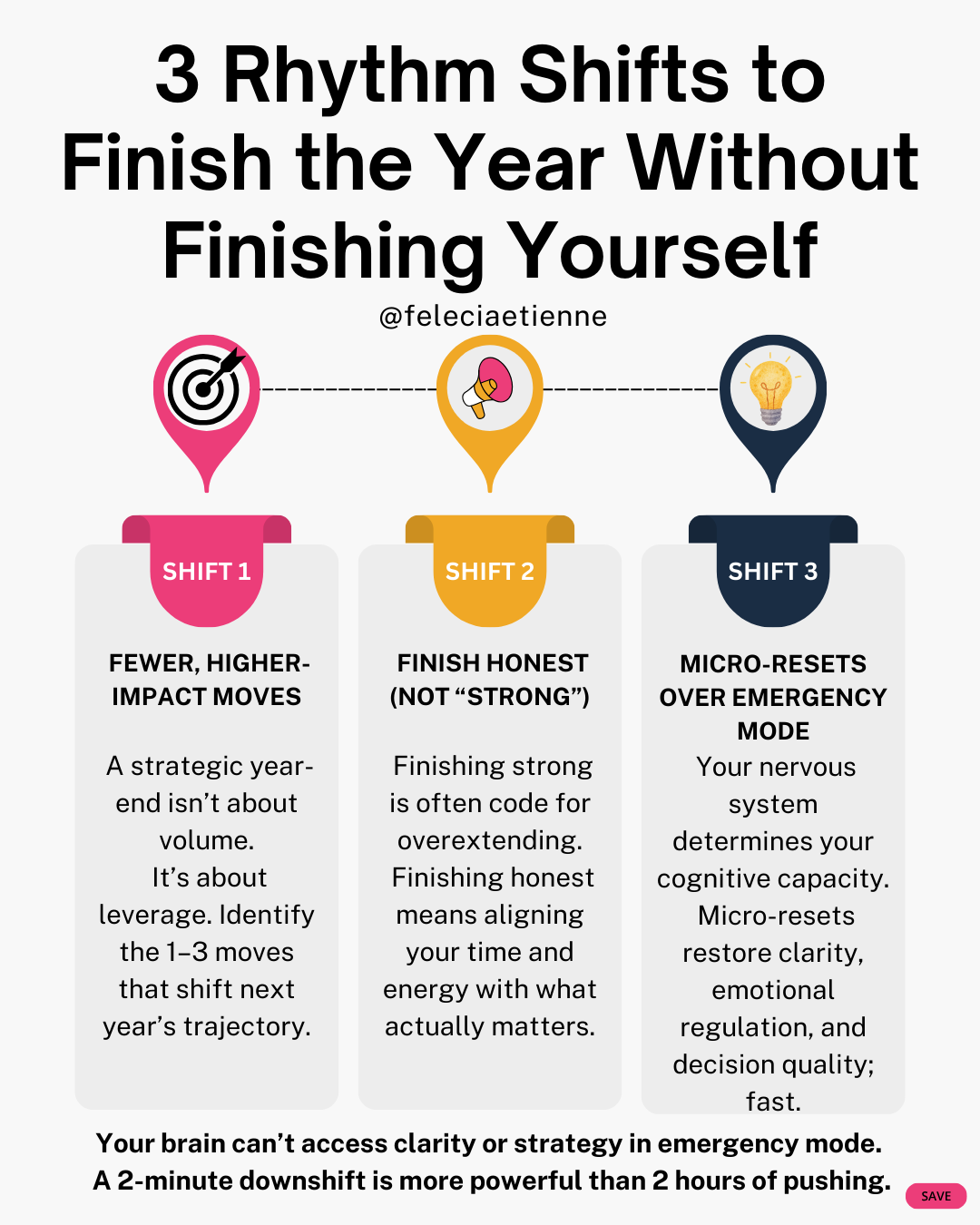
THREE RHYTHM SHIFTS TO FINISH THE YEAR WITHOUT FINISHING YOURSELF
You don’t need another December that leaves you crawling into January. By now, you’re not looking for a pep talk. You’re searching for a lifeline out of the chaos you’ve been managing with sheer willpower.
This is where the shift happens. To finish the year without finishing yourself, three rhythm shifts matter more than any productivity hack or planner. These are the shifts that stop the spiral, unlock your clarity, and remind your nervous system: “We’re safe. We don’t have to live in emergency mode anymore.” Let’s walk through them together.
Rhythm Shift #1: From “Finish Strong” to “Finish Honest”
“Finish strong” is a cultural myth that’s been burning high achievers out for decades. It sounds motivating, but it pushes you to overextend when you’re already depleted. Instead of “finish strong,” let’s finish honest. Honest about what truly matters. Honest about urgency versus ego. Honest about alignment versus obligation.
Let’s do an honest inventory:
What truly matters between now and year-end?
What’s there only because of obligation or fear?
If I took this off my plate, what would actually happen?
Who am I trying to impress by keeping this on my plate?
Maybe it’s a holiday event you said yes to out of guilt. Maybe it’s a client deliverable you could renegotiate. Maybe it’s an unrealistic expectation you set because you thought “high performers don’t slow down.”
related article: Finishing the Year Strong: The 5 Keys to Success
Here’s the truth:
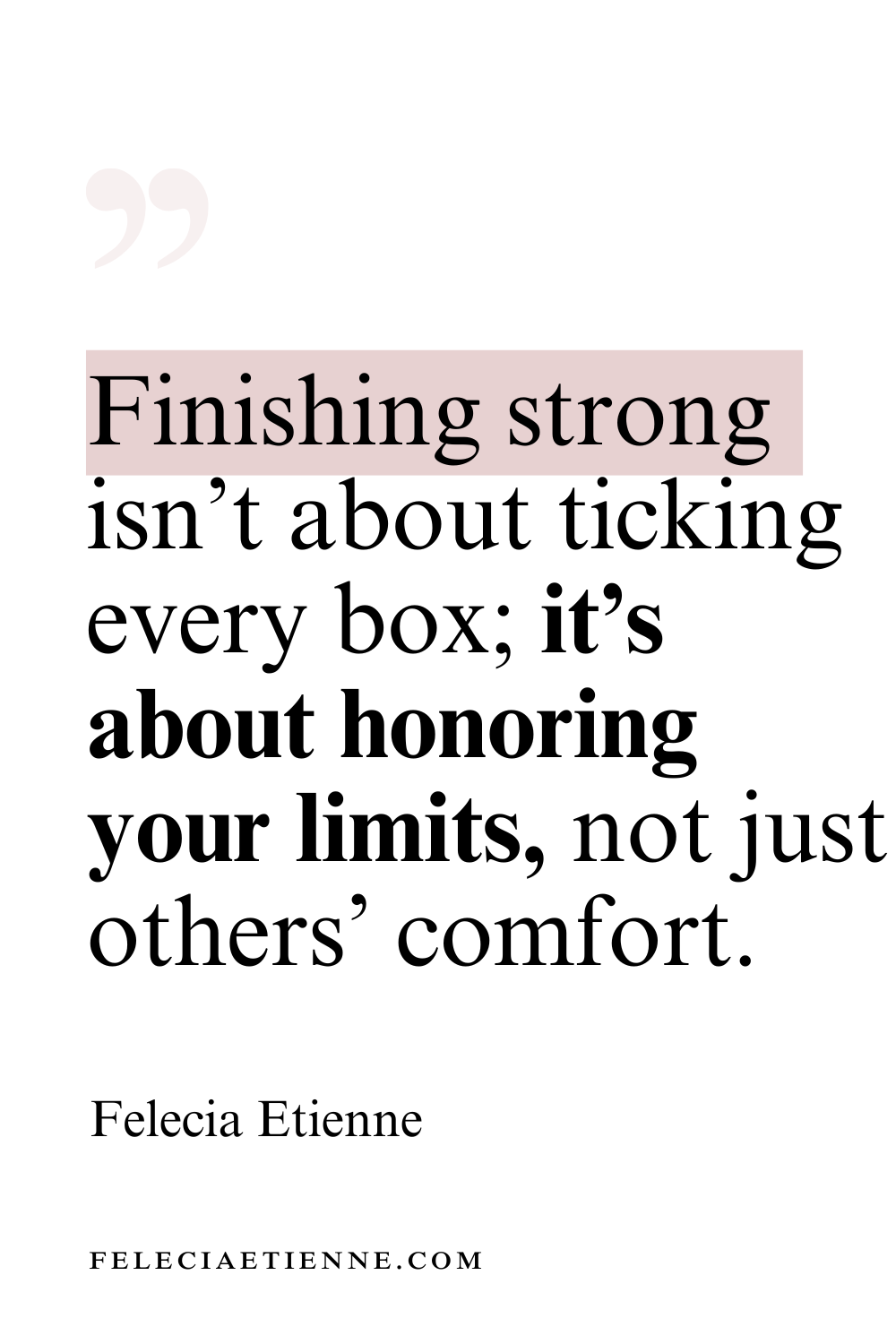
“Finishing strong isn’t about ticking every box; it’s about honoring your limits, not just others’ comfort.”
Your bare minimum is enough. Your worth doesn’t need another performance review. You don’t owe December a version of you that doesn’t exist anymore. When you finish honest, you begin the year aligned.
Rhythm Shift #2: From More Output to Fewer, Higher-Impact Moves
You don’t need more discipline, hours, or productivity systems. You need leverage.
Here’s the high-achiever trap:
When you feel behind, you try to do more. When overwhelmed, you stack more. When clarity fades, you compensate with more. But more is burning you out, not saving you. Instead of squeezing 27 tasks into the year’s end, zoom out and identify the 1–3 moves that shift your 2026 trajectory. Not busywork or low-impact tasks.
The real moves:
One relationship that will matter a year from now.
One system that will save you hours every month in 2026.
One honest conversation that will reduce your invisible labor.
This is where your CEO identity activates. You’re not an employee of your to-do list.
You’re the CEO of your clarity, energy, and execution. CEOs don’t ask, “What do I need to do next?”
They ask: “What matters most for who I’m becoming?” That’s how you stop surviving December and start shaping your future. “Most high achievers don’t need more discipline. They need the courage to do less of what doesn’t move the needle.”
Related article: The 3 Pillars of the Resilient CEO Operating System: How High-Performing Women Entrepreneurs Execute Without Burnout
Rhythm Shift #3: From Emergency Mode to Micro-Resets
This shift changes everything. When your nervous system has been in “brace for impact” mode for months, you can’t think your way into peace. You have to signal your way into it.
That’s where micro-resets come in. Micro-resets are 2–5 minute recalibrations that tell your body: “We’re safe enough to pause.” This rewires your stress cycle faster than any productivity strategy.
Examples:
Three long exhales before every meeting to deactivate your threat response.
A 90-second stretch break between tasks to clear cortisol.
Stepping outside for sunlight to reset your circadian clarity.
Canceling one non-essential thing a week to reclaim bandwidth.
Closing your eyes for 30 seconds, letting your shoulders drop, telling your brain: “We’re not in danger.”
These aren’t “self-care.” They’re physiological pattern interrupters; the stuff high-performance neuroscience has been advocating for years. You don’t reset your life in one big breakthrough.
“You reset it in small, quiet moments where you choose your nervous system over everyone else’s expectations.”

This is where the Rhythm Reset Workbook comes in. It guides you through identifying your current rhythm, choosing your micro-resets, and building a pattern your body and ambition can trust. When you shift your rhythm, you shift your year. When you shift your year, you shift your identity. That’s how you walk into 2026 aligned, capable, and clear, not crawling.
YOUR END-OF-YEAR RHYTHM RESET
(Let’s take a breath together and finish this year differently.)
You’re not behind. You’re not failing. And you’re definitely not “bad at being a high achiever.”
You’ve just been running an entire year on settings that were never designed for the level you’re operating at now.
Of course your body is calling it out.
Of course your brain is tired.
Of course you feel stretched thin, pulled in five directions, and oddly numb in the places you expected to feel proud.
There’s nothing wrong with you. There’s just something off in the rhythm you’ve been forced to survive inside.
High achievers don’t know how to “do average.” We know how to carry things. We know how to push. We know how to be the one people can count on.
But here’s the truth you might not say out loud:
You’re craving a way to lead your life that doesn’t cost you yourself.
And that shift? It doesn’t start with a new planner. Or a color-coded Q1 strategy. Or a “New Year, New You.” It starts with doing what most high achievers were never taught to do: Honor your capacity. Not in theory. In practice. Not once. Daily. Not as a sign of weakness.
As a sign of emotional intelligence and future leadership. Because success at this stage of your life isn’t “Do more.” It’s: Do what matters most, in a way your brain and body can actually sustain.
Your Rhythm Reset Workbook (This Is Your First Step Back to Yourself)
I built this for the woman who’s tired of running on fumes, tired of carrying everything quietly, tired of ending the year feeling like she survived it instead of lived it. This isn’t a productivity template. This is a nervous-system-safe reset. Inside, I walk you through:
An honest audit of what’s really on your plate, not the curated version, the real one.
The micro-resets your nervous system is begging for (but you keep putting off).
How to choose the 1–3 moves that actually matter for closing this year, aligned instead of drained.
How to end December in a way that feels human, grounded, and doable.
Think of it as your “I don’t have to keep doing it this way” moment on paper. “The goal isn’t to drag yourself across December’s finish line. The goal is to cross it with enough energy left to actually enjoy what you built.” If you’re ready to stop being at war with your own bandwidth, this is where we start. Grab the Rhythm Reset Workbook, and give yourself the space to land.
And One More Thing…
Very soon, I’m releasing something brand new: Discover Your Execution Edge™, a quiz designed to finally show you why you work the way you do when it’s time to follow through. Not who you “should” be. Not who you “used to be.”
But the pattern behind your patterns, the part of your Execution Identity that shapes your behavior under pressure. It’s going to make a LOT of things click.
If you want to be the first to get it, make sure you’re on my list when you download the Rhythm Reset Workbook. Because this next season? It’s not about pushing harder. It’s about leading yourself differently. And you’re closer than you think.
FAQ: End-of-Year Exhaustion, Burnout, and Nervous System Overload
1. Why am I so exhausted at the end of the year even when I hit my goals?
Honestly? Because you didn’t just work toward goals this year… you carried the invisible load that never shows up in your metrics. All year long you’ve been making decisions, managing emotions, absorbing pressure, handling “just one more thing,” and being everyone’s go-to. That adds up. This end-of-year exhaustion isn’t a personal failure. It’s what cumulative micro-stress, emotional labor, and decision fatigue feel like in a high achiever’s body. Your nervous system has been “on” for too long, and now it’s letting you know.
2. Is year-end burnout normal for high achievers?
More normal than you think, painfully so. High achievers tend to run on overdrive, not balance. You push through, you rally, you make it happen… and the crash doesn’t show up until December when your body finally whispers, “Hey… we can’t keep doing it like this.” So yes, year-end burnout is common. But that doesn’t mean it’s healthy or inevitable. It just means your system has been carrying more than it was ever designed to carry alone.
3. How do I know if I’m burnt out or just tired from the holidays?
Here’s the simplest way to tell:
Tired goes away with rest. Burnout sticks around, even after you “rest.” If you’re dealing with things like feeling numb or checked-out, snapping at people you care about, a heavier sense of dread, not feeling anything when you hit a win, feeling like everything is “too much and not enough,” that’s not holiday tired. That’s ongoing nervous system depletion. It’s your body saying, “I need you to slow down before I shut down.”
Related article: The Trap of High-Functioning Burnout: When Success Starts to Feel Like Survival
4. Can better time management fix my end-of-year exhaustion?
I wish I could say yes, because it would be easier. But no, this is not a time management problem. You can buy the fancy planner. You can color-code your life. You can block your time, batch your tasks, and still feel behind. Because if your body is in constant emergency mode, no strategy can override that. This is a capacity problem, not a calendar problem.
5. What are practical ways to recover from year-end burnout?
Let’s keep this simple and doable:
Micro-resets (2–5 minutes) to signal safety to your nervous system, honest renegotiation of tasks, deadlines, and expectations, building in buffers, not just back-to-back commitments, stepping outside for real air and sunlight, canceling or rescheduling one thing a week you don’t actually need, using tools that support your body, not just your productivity. Burnout recovery isn’t one big “fix.” It’s a bunch of tiny moments where you choose yourself again.
6. How can I avoid ending next year feeling this exhausted again?
This is the million-dollar question, right? You avoid another December collapse by building a rhythm your body can sustain, not a schedule your brain wishes you could stick to.
Related article: The Performance Trap: Why High Achievers Burn Out Even When They’re Doing Everything "Right"
Three things help more than anything:
The Rhythm Reset Workbook → helps you figure out what to keep, cut, or change so you’re not dragging this year’s exhaustion into next year.
Micro-resets woven into your days → little signs to your nervous system that it’s safe to slow down.
Discovering your execution patterns (coming soon in the Execution Edge™ Quiz) → so you finally understand how you work when it’s time to follow through. If you build from capacity, not guilt, not pressure, not comparison, you won’t end next year feeling like this.

P.S. If you're looking for deeper support as you navigate this transformative journey, here are two ways I can help:
Master Your Mindset: I specialize in helping high achievers, business owners, and professionals break into the top 1% of their field by mastering their mindset and boosting their performance. When you're ready to take your success to the next level, DM me the word "Edge," and let's start that conversation.
Free Resource for Change: Don’t let negative emotions hold you back! Grab my Self-Sabotage Solution Checklist: a free tool designed to help you identify and release the limiting beliefs that no longer serve you. Take the first step toward a more empowered you today!
Embrace this opportunity to shift from burnout to brilliance. Your path to sustainable success starts now!
Ready to achieve your dream life? I’m Felecia Etienne, your go-to Certified High-Performance Coach™ and Mental Fitness Coach. Let me take you on a transformative journey with a Complimentary Unlock Your Performance EDGE call. This isn’t just a chat, it’s your ticket to the high-performance tools and techniques I’ve shared with my coaching clients.
In this personalized call, you'll:
- Dive into your dreams and goals, tackle obstacles, and bridge the gap between where you are and where you want to be.
- Uncover and combat triggers of self-sabotage while discovering untapped strengths.
- You'll walk away with actionable strategies that deliver immediate impact
Equip yourself with the strategies, resources, and support needed to shatter obstacles, self-sabotaging, narrow the gap, and transform your ambitions into tangible achievements. Ready to escape inertia and boost your impact? Book a private and confidential session. Unlock Your Performance EDGE with Felecia. Let's unlock your potential together.
To find out more about Felecia, you can visit her website at feleciaetienne.com.
Social Media Handles:
Feeling stuck and unfulfilled? It's time to break free from self-sabotage!
Download our Self-Sabotage Solution Checklist and
start your journey to personal mastery today.